Key Takeaways
- Faster Kicks – Achieve maximum velocity by staying loose until the moment of impact, ensuring muscle tension doesn’t act as an internal brake.
- Master the standing foot pivot to fully unlock your hips, transforming a heavy pushing motion into a high-speed, whip-like strike.
- Eliminate “telegraphing” by maintaining a tight chamber and vertical posture, keeping your kicking path as compact as possible to slash execution time.
- Use explosive plyometrics and resistance bands to prime fast-twitch fibers, aiming for a sharp recovery reset that lets you fire a follow-up strike instantly.
Achieving faster kicks requires a blend of explosive hip power and refined motor patterns. By minimizing “telegraphing” movements and staying completely relaxed until the exact moment of impact, you can transform a heavy, pushed strike into a high-speed whip.
To develop this elite striking velocity, consistent repetition and plyometric drills are essential. Correcting your lead foot placement and engaging fast-twitch fibers can instantly shave fractions of a second off your wind-up time, making your kicks significantly harder for any opponent to track or parry.
What Makes Faster Kicks ? The Balance Between Speed and Power
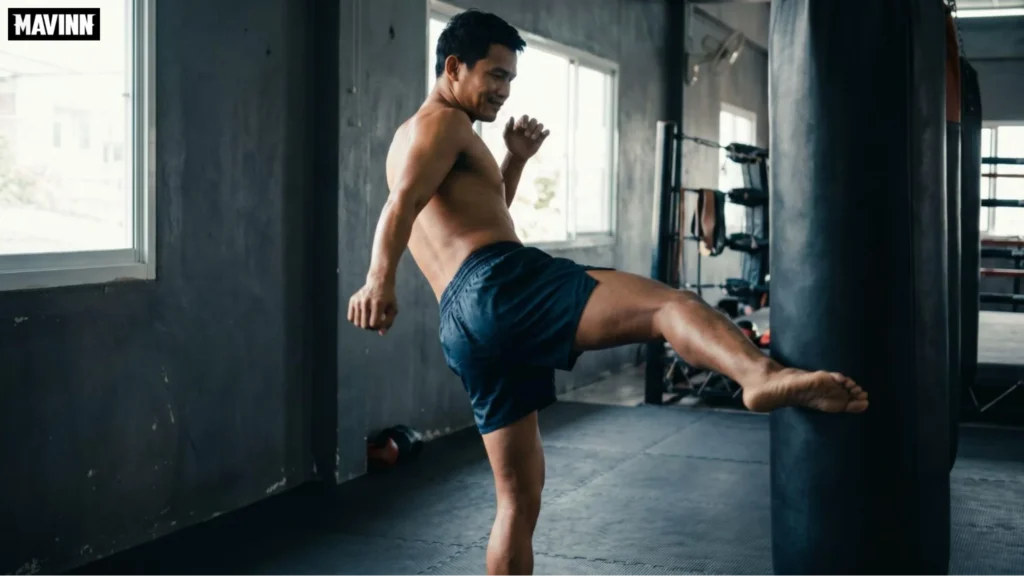
Faster kicks depend on your ability to remain completely relaxed until the split second of impact. Excessive muscle tension during the wind-up creates internal resistance, which slows your leg down and telegraphs the move to your opponent. We focus on a whip-like motion where the leg stays loose, only “locking in” the power at the final moment of the strike.
Balancing speed and power requires shifting your focus from “pushing” through a target to “snapping” against it. While raw strength provides a foundation, velocity is the primary multiplier of force because kinetic energy scales with the square of velocity. Striking specialists often trade a small amount of peak torque for noticeably greater velocity, making the kick much harder to track or parry.
- Pivot Rotation: Turning your standing heel toward the target opens the hips for an unobstructed path.
- Chambering: Keeping the knee tight during the initial lift reduces the lever length for faster acceleration.
- Core Recruitment: Using the obliques to pull the hip forward adds significant mass behind the speed.
Essential Mechanics for Faster Kicks

Faster kicks are achieved by eliminating telegraphing movements and maintaining total muscle relaxation until the exact moment of impact. You must prioritize a whip motion over a push motion to maximize velocity, as kinetic energy scales with the square of velocity. Striking specialists often reduce peak torque in favor of a meaningful velocity boost, making the strike nearly impossible to parry or counter.
Success depends on a tight chamber and a sharp pivot of the standing foot to open the hips for an unobstructed path. Keeping your knee tucked close to your body reduces the lever length, which allows your leg to accelerate significantly faster through the hitting arc. A high-cut training short profile keeps hip rotation completely unhindered through the final moment of the strike.
| Mechanic | Speed Impact | Execution Detail |
|---|---|---|
| Muscle State | High | Stay relaxed until the point of contact to avoid internal resistance. |
| Chambering | Medium | Keep the knee tight to the chest to decrease the lever arm and accelerate. |
| Pivot Rotation | Critical | Rotate the standing heel at least 90–180 degrees to clear the hip joint. |
Stop Telegraphing Your Moves
Eliminate pre-kick “tells” like dropping your lead hand or shifting your weight too early to generate strikes that land before your opponent can react. Most fighters subconsciously twitch their shoulders or “wind up” their hips, giving away their intent a fraction of a second before the leg actually moves. Keep your upper body relaxed and maintain a consistent guard to ensure your movement remains unpredictable and explosive.
Hide the trajectory of your strike by lifting your knee straight toward the target before rotating your hips into the kick. This “chambering” technique prevents the leg from swinging in a wide, visible arc that is easy for an opponent to time and counter. Practice launching the kick from a dead stop without any shuffling or pre-step adjustments to maximize your deceptive speed.
Focus on “quiet” eyes and steady breathing to avoid signaling your intensity level to a seasoned defender. Masking your footwork with a jab or a simple hand feint forces the opponent to focus on your upper body while your leg is already in flight. Removing these unnecessary movements can substantially increase your effective strike speed in live sparring.
The Snap and Recoil Technique
The snap and recoil technique generates faster kicks by maximizing the velocity of your lower limb through a rapid release of tension at the point of impact. You must keep your leg muscles relaxed during the chamber and extension phases, only tightening them for a fraction of a second when the shin or ball of the foot hits the target. This whip-like motion creates a stinging effect that is significantly harder for an opponent to track than a heavy, pushed strike.
Retracting your leg as fast as you threw it is the secret to maintaining balance and preventing your kick from being caught. Instead of letting your leg drop or linger on the target, you must pull your heel back toward your glute immediately after the strike lands. Professional fighters reset their lead foot to the floor almost instantly to stay ready for a follow-up punch or defensive check.
We recommend practicing this on a heavy bag by focusing on the sound of the impact rather than the depth of the dent. A fast kick should produce a sharp, loud crack, indicating high surface velocity and an instant retraction. Focus on snapping your hip over at the final moment to drive the force through the target before snapping the leg back to your stance.
Proper Hip Rotation and Pivot
You cannot achieve faster kicks without rotating your hips through the target and pivoting on the ball of your standing foot. This mechanical shift transforms your leg from a lifting limb into a swinging bat, using torque rather than just leg muscle to accelerate.
To master this movement, focus on these three technical cues:
1. Step out at a 45-degree angle to create the necessary space for your pelvis to turn.
2. Push off the ball of your lead foot to initiate a 180-degree pivot that reduces ground friction.
3. Drive your kicking hip over the top of the standing leg to snap the shin through the impact zone.
Failing to pivot forces your leg to move in a slow, upward arc. A sharp pivot allows you to maintain a vertical posture, keeping your center of gravity stable while the leg whips across the horizontal plane. Avoid “muscling” the kick and let the hip rotation provide the speed.
Best Drills to Develop Faster Kicks and Explosive Power
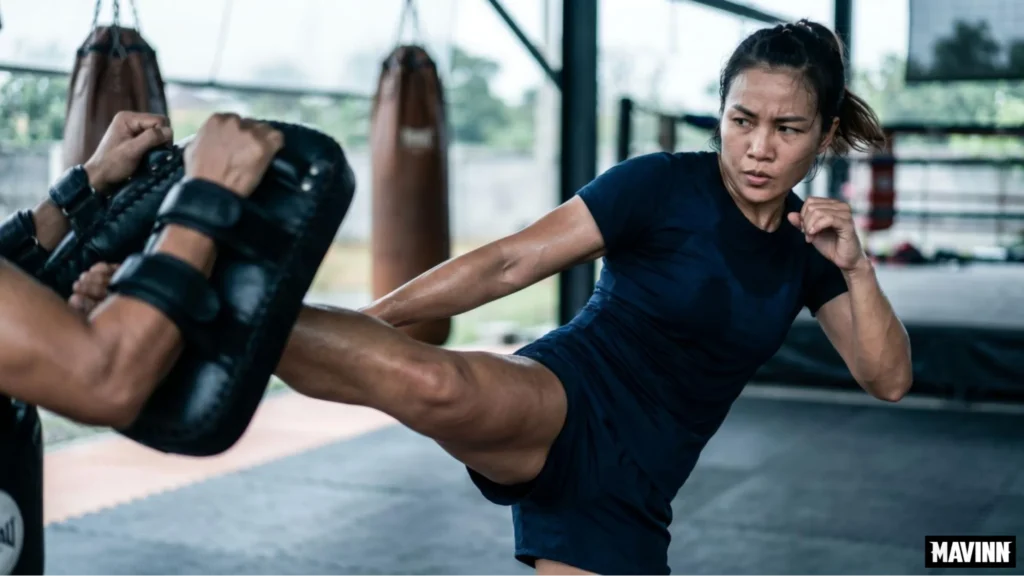
You build faster kicks by prioritizing neurological firing speed through high-volume speed repetitions and explosive plyometric movements. We recommend performing speed sets on a heavy bag where you throw 10 to 20 non-stop kicks per leg to train the hip flexors and core for rapid recovery. This method shifts your focus from raw impact to the speed of the chamber and reset, which is critical for landing multiple strikes in a single exchange.
Explosive power comes from the ground up, requiring you to bridge the gap between strength and velocity using weighted jumps or sprints. Integrating box jumps or burpee-to-knee strikes develops the reactive force needed to launch a kick with zero telegraphing. If you can move your body weight vertically at high speeds, you will generate significantly more torque during the rotational phase of a Muay Thai roundhouse.
Relaxation is the final component of a fast strike, as tense muscles act like brakes on your movement. You must keep your limbs loose until the point of impact to maximize the “whip” effect generated by your lead shoulder and hip. Professional nak muay often spend entire rounds throwing light, fast kicks to master this rhythm without fatiguing the central nervous system.
Plyometrics and Core Training
Plyometrics and core stability bridge the gap between raw strength and the explosive snap required for Faster Kicks. Exercises like box jumps and depth jumps train your muscles to transition from extension to contraction in a fraction of a second. This neural adaptation ensures your nervous system fires motor units at peak velocity rather than just grinding out heavy, slow repetitions.
Your core acts as the essential transmission system that transfers ground force through your hips and into the strike. Rotational drills like medicine ball slams stabilize the spine while allowing the pelvis to whip the leg with maximum torque. A soft midsection causes energy leaks that drain significant potential striking speed.
- Box Jumps: Builds the vertical power and explosive hip extension needed for high kicks.
- Med Ball Rotational Throws: Develops the lateral torque that drives a heavy roundhouse.
- Depth Jumps: Optimizes the stretch-shortening cycle for immediate recoil and speed.
Resistance Band & Heavy Bag Drills
You build faster kicks by using resistance bands to overload the chamber and extension phases of the striking movement. This constant tension forces your hip flexors and glutes to fire with maximum intensity against an external load. Once you remove the band, your nervous system remains primed, resulting in an immediate velocity boost during your next 15 unresisted repetitions.
1. Contrast Striking: Execute 5 power kicks on the bag with a resistance band anchored to your ankle, followed by 5 unresisted kicks at full speed.
2. Banded Chamber Holds: Raise your knee to the chamber position against band tension and hold for 3 seconds before snapping the kick into the heavy bag.
3. Rapid Switch Drills: Perform 20 seconds of continuous alternating mid-level kicks while wearing a heavy-duty glute band just above your knees to ignite the abductors.
We recommend integrating these drills into your session twice a week to see a measurable improvement in your reaction time and leg snap. Focus on maintaining a tight core and upright posture to ensure the power is generated from the hips rather than leaning away from the bag. Consistent resistance training reduces the “telegraphing” of your strikes by strengthening the muscles responsible for the initial lift of the leg.
Hip Mobility Unlocks Higher and Faster Kicks
You achieve faster kicks by removing the internal resistance in your hip joints that acts like a physical brake on your movement. High-level mobility allows your femur to rotate freely, ensuring power transitions from your core to your shin without energy leaks. Fighters with restricted hips often compensate by leaning their torso too far back, which significantly slows down the recovery phase.
Dynamic hip flexibility enables you to reach targets like the head or neck without sacrificing balance or telegraphing your intentions. When your psoas and adductors are supple, you can chamber the leg higher and snap it forward with explosive velocity. We prioritize active end-range strength over passive stretching to build mobility you can actually use during a high-intensity round.
A lack of external rotation often forces the knee to take the strain, leading to chronic injuries that sideline your training progress. Professional Muay Thai practitioners use 90/90 hip switches and tactical prying to keep their lead leg a high-speed weapon. Dedicate at least 15 minutes to targeted hip drills three times a week to sharpen your striking arc.
Common Mistakes That Ruin Faster Kicks
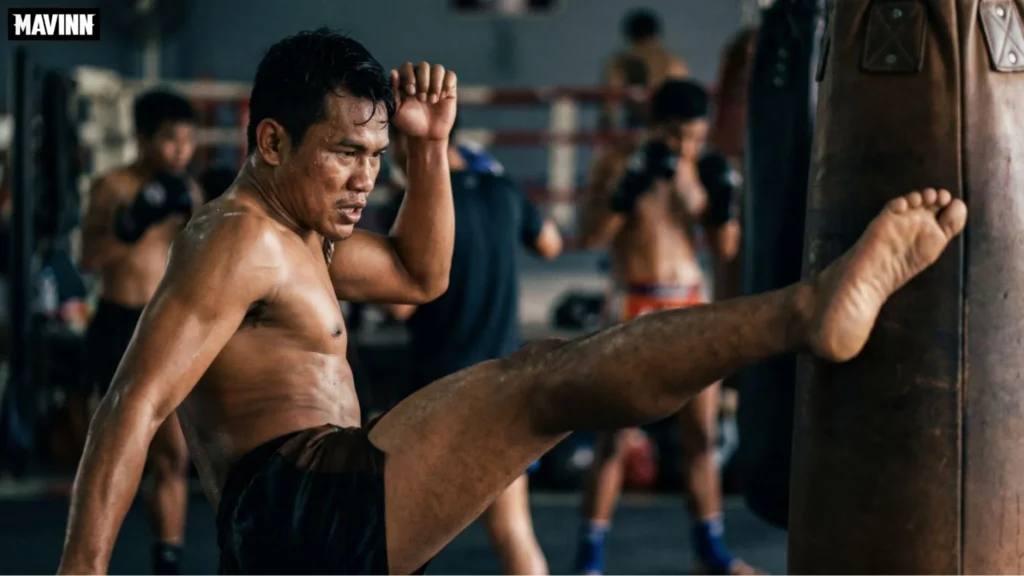
Telegraphing your strike through “winding up” or dropping your guard gives your opponent a clear signal to counter or evade. Most fighters add an unnecessary delay by dipping their shoulder or taking an exaggerated lead step before the leg even lifts. Removing these micro-movements turns a readable strike into a sudden, invisible blow that lands before the opponent can reset their guard.
Holding excessive tension in your quads and hip flexors creates internal friction that drags your leg through the air. You must maintain relaxed muscles until the millisecond of impact to allow your limb to function with whip-like velocity. Rigid muscles act as a physical brake, noticeably reducing your potential striking speed while draining your aerobic tank faster.
| Error Type | Effect on Kick | Expert Fix |
|---|---|---|
| Shoulder Dipping | Signals intent early | Keep guard high and still |
| Over-Chambering | Wastes energy and time | Use a direct, diagonal path |
| Rigid Standing Leg | Limits hip rotation | Pivot on the ball of the foot |
Leaning your torso too far away from the target to find balance ruins your recovery time and leaves you vulnerable to a counter-sweep. This common habit shifts your center of gravity too far back, preventing you from retracting your leg to a defensive stance quickly. Keeping a tall posture allows your hips to roll over effectively, ensuring the power comes from rotation rather than falling into the kick.
Tensing Muscles Too Early
Tensing your muscles at the start of a strike creates internal friction that acts like a brake, preventing you from achieving Faster Kicks. You must keep your legs and core relatively loose during the initial phase of the movement to allow for maximum acceleration. Think of your leg as a whip; the speed comes from fluid motion rather than rigid strength.
When you stiffen up too early, your antagonistic muscles fight against the primary movers, which significantly reduces the velocity of your shin. Stay relaxed until the final phase of the movement where you turn your hip over and impact the target. This “snap” at the end generates the force while a loose limb travels much faster through the air.
Focus on exhaling as you initiate the kick to help release upper body tension that often travels down to the hips. Professional Nak Muay often keep their hands active and shoulders dropped to ensure their lower body remains explosive. Practice your technique at 50% power on the heavy bag to master the transition from a relaxed swing to a rigid impact.
Overextending & Sacrificing Form
Overextending kills your momentum and leaves you vulnerable, directly preventing you from achieving faster kicks. When you lean too far past your center of gravity, your muscles work harder to stabilize your frame rather than to accelerate the limb. This instability creates a “reset lag” that adds significant time to your recovery.
Sacrificing form for raw effort leads to telegraphing, where your shoulders tilt significantly before the leg even leaves the ground. Speed relies on a compact rotation and a sharp snap, not on throwing your entire body weight into a wild, off-balance arc. Keep your spine vertical and rotate on the ball of your lead foot to maintain a tight, efficient striking path.
Experienced fighters often hold back from full maximum output to ensure they can return to a defensive stance immediately. This prevents the “falling off” effect that leaves you open to counters if your kick misses the target. Practice shadowboxing in front of a mirror to verify that your head remains centered over your hips during the full extension.
Choosing the Right Gear for Faster Kicks
You achieve faster kicks by minimizing air resistance and ensuring your hips have an unrestricted range of motion. Lightweight Muay Thai shorts with high-cut side slits are essential to prevent fabric from catching during explosive hip rotation. Modern training shorts built with lightweight synthetic blends resist sweat absorption, keeping your equipment light through a high-intensity training session.
Bulky protection adds unnecessary mass to your lower extremities, which significantly slows down your striking velocity. Streamlined shin guards built with high-density foam provide reliable impact resistance at a noticeably lighter total weight than bulkier traditional models. This reduction in drag allows for a quicker snap and a faster return to your fighting stance.
- High-cut side slits for maximum hip flexibility.
- Ultra-lightweight fabrics to reduce gravitational drag.
- Low-profile padding that maintains an aerodynamic profile.
- Moisture-wicking technology to prevent weight gain from perspiration.
How to Measure and Track Your Faster Kicks Progress
You track progress toward faster kicks by measuring the total time required to complete a high-volume set or by using frame-by-frame video analysis to calculate velocity. Record yourself performing 50 consecutive roundhouse kicks on a heavy bag to establish a baseline duration for your current conditioning. A fighter aiming for elite speed should target finishing 50 powerful strikes in under 60 seconds without compromising their technical form.
1. Total Volume Time: Record the exact seconds taken to complete 10, 30, or 50 repetitive kicks to gauge anaerobic endurance.
2. Frame Data: Count the number of video frames from the moment your foot leaves the floor until it hits the target.
3. Reset Speed: Measure how quickly your kicking foot returns to a balanced fighting stance after impact.
Modern training often incorporates wearable sensors or mobile apps to pinpoint the exact millisecond of each strike’s execution phase. We recommend tracking your “reset” time specifically — a professional-grade recovery phase should be sharp and almost immediate. Maintain a digital log of these metrics every four weeks to ensure your plyometric drills are translating into measurable explosive power.
Conclusion
Developing faster kicks requires a fundamental shift from raw power to optimized muscle relaxation and fluid hip mechanics. You must train your body to remain loose until the millisecond of impact to prevent “telegraphing” your movement to a seasoned opponent. Professional strikers often dedicate the majority of their bag sessions to speed-focused drills rather than heavy power hitting.
Integrate plyometric movements like box jumps with high-volume technical rounds to translate explosive strength into functional combat speed. We suggest prioritizing the retraction phase of the kick, as a fast reset allows for immediate follow-up strikes or defensive maneuvers. Aim to shorten your total execution time for a standard roundhouse — every fraction of a second saved keeps you effective in high-level sparring.