Key Takeaways
- Learning muay thai at home – Build your foundation on technical precision and correct body mechanics, such as hip rotation and stable weight distribution, rather than raw power.
- Establish a dedicated training space of at least 2×2 meters with non-slip foam tiles, a full-length mirror for real-time self-correction, and 180-inch hand wraps to protect your wrists.
- Record video of your shadowboxing from a side angle to identify defensive flaws like dropping your guard, allowing you to self-correct your alignment without a live coach.
- Prioritize stance stability and footwork drills for the first 30 days to build muscle memory and prevent joint strain before moving on to heavy bag training.
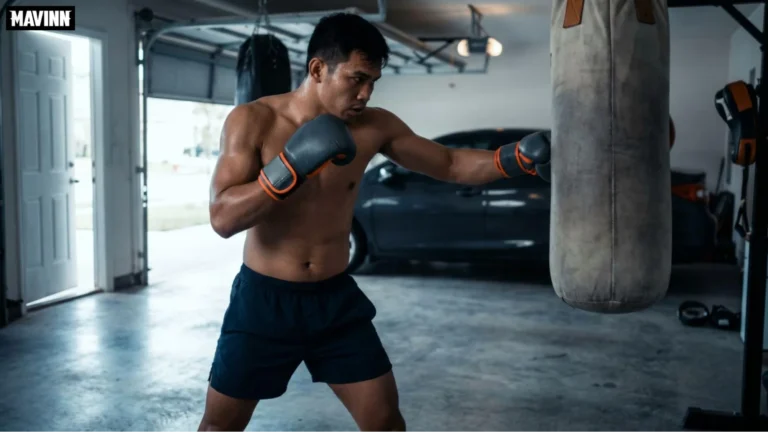
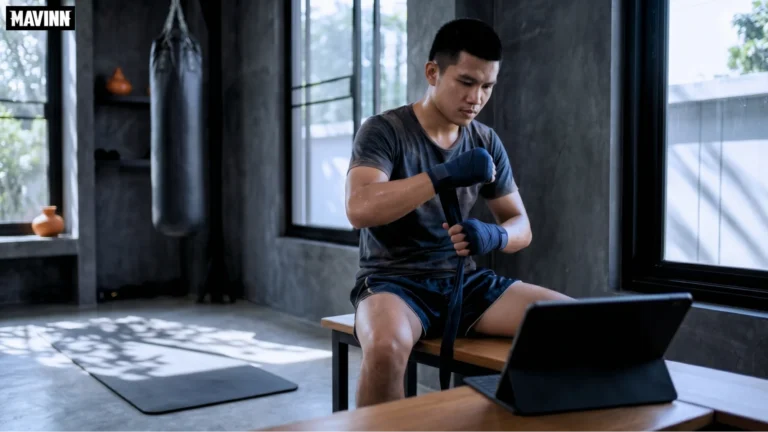
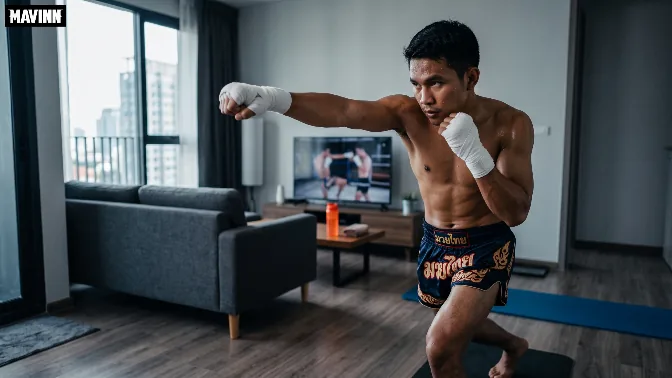
You can build authentic striking power and master fundamental defense by learning muay thai at home through structured, fighter-led video programs. Shadowboxing, heavy bag work, and footwork drills allow you to develop real combat conditioning without step-in sparring partners.
To prevent injury, we focus on technical precision like rotating your hips on kicks and keeping your guard high. Our training curriculum brings the exact methodology from our Bangkok and Pattaya camps directly to your living room.
Home training as your foundation
You can build genuine conditioning, stance stability, and clean striking mechanics at home through solo drilling. The one thing solo work cannot replace is live sparring, so treat home training as the foundation you bring into the gym later, not a full substitute for a coach.
For the full feasibility breakdown, read whether you can learn Muay Thai at home.
Setting up your training space and basic gear
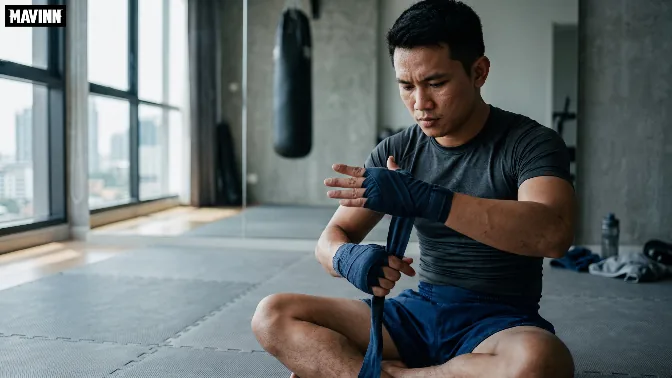
You need a clear 2×2 meter floor area and three essential pieces of gear to start learning Muay Thai at home effectively. This clearance ensures you can swing kicks and shadowbox without hitting walls or furniture. We recommend laying down high-density EVA foam mats over concrete or hardwood to protect your joints during rapid pivoting.
Hand wraps and boxing gloves are non-negotiable, even if you are training solo through our online courses. Beginners should opt for 12oz or 14oz gloves to build shoulder endurance while keeping knuckles protected. If you install a punching bag, choose a 100-pound Muay Thai banana bag that hangs low enough for low kicks.
What do you actually need to get started ?
To start learning Muay Thai at home, you only need two square meters of open floor space, a reliable internet connection, and hand wraps. You do not need heavy bags or expensive equipment to master the basic stance, footwork, and shadowboxing. We advise starting with shadowboxing to build muscle memory before adding heavy gear.
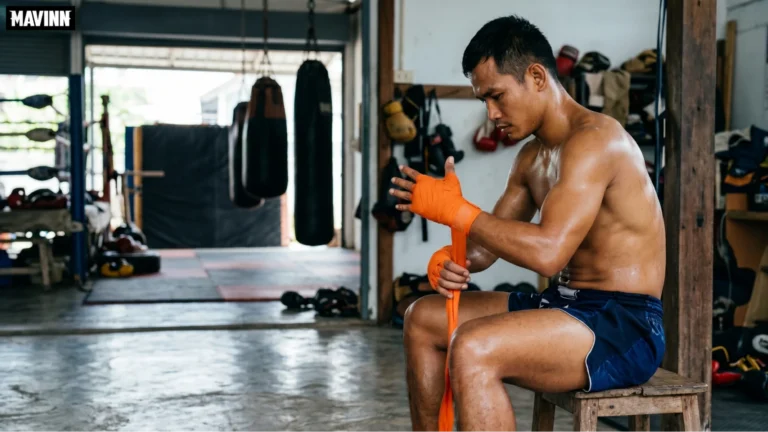
- 180-inch hand wraps to support your wrist joints and protect your knuckles.
- A full-length mirror to self-correct your guard, hip rotation, and balance in real-time.
- A non-slip surface like interlocking foam tiles to prevent slipping during pivot turns.
Investing in 14-ounce boxing gloves and a heavy bag comes later once you transition to impact training. For the first 30 days, focus entirely on footwork alignment to prevent joint strain. For structured progression, we offer online courses led by world-class striking specialists like Superbon Singha Mavinn.
How to practice safely without a partner
You can practice safely without a partner by prioritizing shadowboxing in front of a mirror and executing slow, controlled movements on a heavy bag. This approach prevents hyperextension of your joints and ensures you maintain proper balance during solo sessions. If you throw strikes with maximum power into empty air, you risk injuring your elbows and knees.
Here are key safety rules for learning muay thai at home alone:
- Wrap your hands every session to protect the small bones in your wrists and knuckles.
- Clear a 3×3 meter space of all obstacles to prevent tripping during footwork drills.
- Film your sessions from a side angle to check if your hand drops when kicking.
We design our online courses to emphasize these structural alignments so you build correct habits. Practicing the rear roundhouse kick at half-speed helps you master the standing-foot pivot without losing balance.
Mastering the fight stance and footwork first
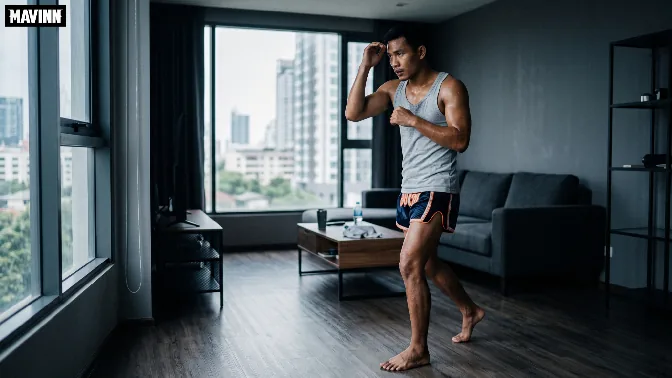
You must establish a solid stance and fluid footwork before throwing a single strike to prevent injury and maintain balance when learning Muay Thai at home. A proper stance requires keeping your feet shoulder-width apart, your hips angled at 45 degrees, and your hands guarding your face. This positioning distributes your weight evenly, allowing you to transition between offense and defense without losing your footing.
Footwork is the engine of your striking, meaning you must always move your lead foot first when advancing and your rear foot first when retreating. Crossing your legs or dragging your feet disrupts your base, leaving you vulnerable to counter-attacks during shadowboxing. Our online programs emphasize drilling these directional steps for 10 minutes daily on a flat surface to build permanent muscle memory.
Finding your perfect stance
Your Muay Thai stance must balance offensive power and defensive mobility, starting with your dominant side positioned in the rear. When learning muay thai at home, establishing this foundation prevents you from losing balance during strikes. Set your feet shoulder-width apart and turn your hips at a 45-degree angle.
- Place your non-dominant foot forward, pointing straight ahead.
- Raise your rear heel 1 inch off the floor to keep your weight springy.
- Bring your fists up to eyebrow level with your elbows tucked to shield your ribs.
Keep your weight distributed 50/50 between both legs to check kicks instantly. World-class strikers like Superbon Singha Mavinn micro-adjust this distribution to disguise lead attacks. Practice stepping in all four directions for 5 minutes daily to lock in this muscle memory.
Moving forward, backward, and laterally
You must maintain your fighting stance during all directional movements when learning muay thai at home to avoid getting swept or knocked off balance. Always push off the opposite leg of the direction you want to travel to maintain a stable base. This fundamental mechanic ensures your feet never cross, keeping you ready to strike or block instantly.
- Forward and backward: Push off your back foot to step forward with your lead foot, then slide your back foot up to regain your stance. Reverse this sequence when retreating.
- Lateral movement: Step with your left foot first when moving left, and your right foot first when moving right, ensuring your feet always remain shoulder-width apart.
Learning the basic strikes of the eight limbs
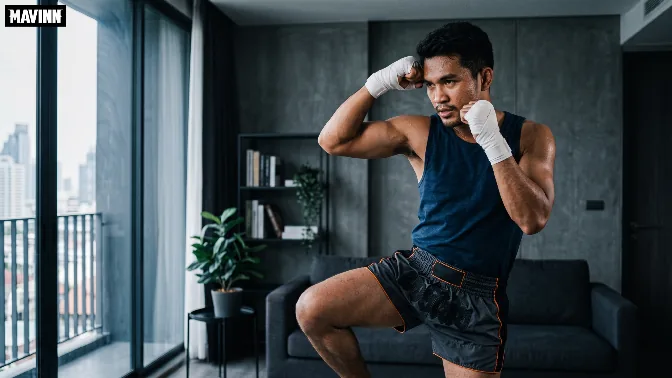
You must master the precise coordination of your punches, kicks, knees, and elbows to build a functional foundation when learning muay thai at home. These tools form the Art of Eight Limbs, requiring you to use your body’s natural weapons symmetrically to generate maximum force. To practice safely without a live partner, focus on shadowboxing in front of a mirror to check that your hands return to cover your chin after every strike.
We structure our online training programs to break down the mechanics of the lead jab, rear cross, roundhouse kick, horizontal elbow, and straight knee. Our system, guided by world-class striking specialist Superbon Singha Mavinn, emphasizes rotational power from your hips rather than raw arm strength. Pivoting your lead foot fully during a roundhouse kick instantly unlocks the hip rotation needed for a powerful blow.
Perfecting your punches jab, cross, and hook
Perfecting your jab, cross, and hook while learning Muay Thai at home requires mastering hip rotation and weight transfer rather than just throwing your arms. Focus on maintaining a tight guard to protect your face during every single exchange.
- Lead with the jab by extending your front hand straight from your chin and rotating your knuckles downward at impact.
- Deliver the cross by pushing off your rear foot, rotating your hips, and driving your fist straight down the center line.
- Throw the hook by pivoting your lead foot 90 degrees and swinging horizontally with your elbow locked at a 90-degree angle.
Train in front of a mirror to spot technique errors and dropping hands instantly. Throw these punches in combinations of 100 repetitions daily to cement correct muscle memory.
Throwing powerful roundhouse kicks and push kicks
Generating maximum power in your roundhouse kicks and push kicks when learning muay thai at home depends entirely on mastering your hip rotation and center of gravity. Your legs are your longest and heaviest weapons, meaning improper form can easily throw you off balance during solo practice. To prevent this, you must treat your standing foot as the primary pivot point for all kicking movements.
- Roundhouse Kick: Swing your kicking leg like a baseball bat while pivoting your standing foot 180 degrees to open your hips.
- Push Kick (Teep): Lift your lead knee to your chest, then drive your hips forward to thrust the ball of your foot into the target.
Practice these strikes separately for 50 repetitions per leg on each side daily to build hip flexibility and core stability. Always snap your kicking leg back to your starting stance immediately after impact to avoid getting off balance.
Incorporating knees and elbows into your combos
You transition from long-range strikes to close-quarters weapons by using the momentum of your punches to close the distance for knees and elbows. When learning Muay Thai at home, shadowbox a jab-cross combination, then immediately step forward to drive a straight rear knee. Keep your opposite hand glued to your temple to guard against simulated counter-attacks.
Follow the knee strike by dropping your foot forward to pivot into a horizontal lead elbow. This positioning uses your hip rotation to generate short-range power without winding up. Always keep your shoulder elevated to shield your chin as you slash across the target.
Building a weekly home training routine
A balanced week mixes technique days with conditioning and active recovery. Train three to four times a week so your body adapts to rotational striking without overuse, and start every session with a 10-minute dynamic warmup. Record your final round each week to track your hip rotation and guard height over time.
For a full weekly plan and a ready-made daily blueprint, follow our complete at-home Muay Thai training program.
How to self correct your technique without a coach
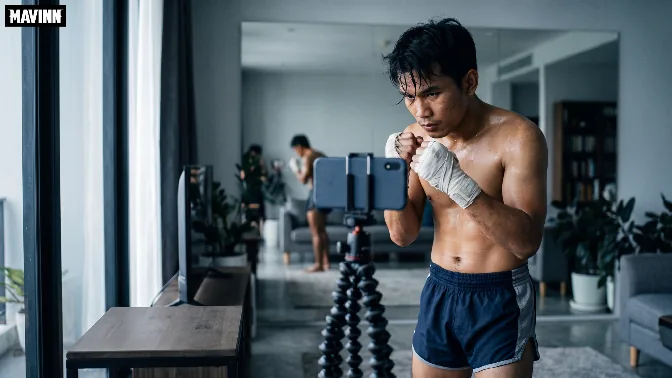
Recording your training sessions from multiple angles and comparing your movement to high-quality reference footage is the most effective way to self-correct when learning muay thai at home. Set up your phone at hip height to capture your entire body, focusing specifically on your feet and hips during transitions. Analyze the footage to ensure your rear heel lifts during punches and your guard remains high, which instantly flags alignment issues like a dropped rear shoulder.
Tactile feedback tools also help bridge the gap when you do not have a trainer watching your every move. We recommend training next to a wall to keep your roundhouse kicks tight and prevent your leg from swinging too wide. Brushing the wall indicates you must pivot your lead foot further to force your hip over the centerline.
Using mirrors and video recordings to fix mistakes
You must use mirrors for real-time adjustments and video recordings for delayed analysis to eliminate blind spots when learning muay thai at home. Shadows and bad angles often hide critical flaws like dropping your rear hand during a kick or flaring your elbows during a punch. Correcting these structural mistakes immediately prevents your brain from hardwiring faulty movement patterns.
Set up your camera at chest height to capture your full body from both the front and side profiles. Use these two visual tools to audit your posture against these specific checkpoints:
- Observe your guard in the mirror to ensure your hands return to cover your face after every strike.
- Record a 3-minute round of shadowboxing and play it back at 0.5x speed to analyze weight distribution and balance during footwork transitions.
Watching and analyzing professional fights
You accelerate your progress when learning muay thai at home by actively analyzing professional fight footage to study setups, defensive reactions, and tactical adjustments. Do not watch as a passive spectator; instead, focus on a single weapon or movement pattern for an entire round. Track how elite fighters set up their rear roundhouse kicks using hand combinations or look for subtle weight shifts that telegraph an incoming attack.
Analyze defensive habits by observing how fighters reset their guard or counter immediately after blocking a strike. Note the specific angles they use to escape the ropes and return to the center of the ring. You can replicate these exact movement sequences during your shadowboxing sessions to build practical combat intelligence.
Transitioning from your living room to a real gym
You must transition from solo practice to a fully equipped gym when your home workouts can no longer replicate the unpredictable timing of a sparring partner or the resistance of heavy bags. While learning Muay Thai at home builds your basic mechanics, a physical gym environment introduces crucial variables like distance management and target movement. Making this shift allows you to test your alignment against real-time resistance rather than just shadowboxing in the air.
To prepare for your first class, focus on stamina conditioning during your final weeks of home training. Gym sessions typically run for 90 minutes and demand sustained cardiovascular endurance that solo drills rarely replicate. We recommend booking a specialized training package, such as our Stay & Train program in Pattaya or Bangkok, to immerse yourself in structured, coach-led sessions.
Why in person coaching at Mavinn Muay Thai takes you to the next level
In-person coaching at Mavinn Muay Thai elevates your skills by providing immediate, hands-on adjustments that are impossible to replicate when learning Muay Thai at home. While solo drills build basic muscle memory, practicing in front of a mirror cannot replace the tactile feedback of a trainer correcting your hip alignment or guard height mid-strike. We design our gym sessions to bridge this gap through dynamic, interactive training.
- Live target pad work: Training with our coaches forces you to adjust your timing, distance, and head movement against a moving target.
- Instant technical correction: Coaches spot subtle errors in your stance and weight distribution, preventing bad habits before they lock into your muscle memory.
Our Stay & Train packages combine these intensive live sessions with structured progression to accelerate your development. Training under active resistance ensures you pivot your lead foot fully on every roundhouse kick.
Exploring Bangkok and Pattaya packages for all levels
Our Stay & Train packages in Bangkok and Pattaya bridge the gap between learning Muay Thai at home and training in a professional camp environment. You can choose our Nuanchan branch in Bangkok for intense city training or our Pattaya camp for endurance conditioning. Both locations accommodate all skill levels by offering two daily group classes tailored to your current fitness.
| Camp Location | Primary Focus | Training Environment |
|---|---|---|
| Bangkok (Nuanchan) | Technical precision | Professional urban facility |
| Pattaya | Endurance and cardio | Focused conditioning environment |
Applying the hand-eye coordination you built while learning Muay Thai at home to live pad work accelerates your overall technical development. Our onsite trainers evaluate your stance, correct your hip rotation, and integrate defensive counters into your routine. Each training day concludes with a dedicated 30-minute sparring session to test your defensive guard under light pressure.
Common questions about home training answered
Can you learn Muay Thai at home with no equipment ?
Yes, you can successfully begin learning muay thai at home with absolutely zero equipment. Without gloves or heavy bags, your primary objective is mastering structural alignment and movement mechanics. We design our online training programs to help you shadowbox effectively, utilizing your own reflection to correct alignment errors in real time.
Empty-hand training allows you to build flawless muscle memory without the distraction of hitting a physical target. You can develop your cardiovascular endurance and explosive power using targeted bodyweight movements. Committing to a 30-minute daily routine of shadowboxing and footwork drills builds the hip stamina needed to execute 100 consecutive kicks.
How long does it take to see progress ?
You will see noticeable improvements in your cardiovascular endurance and basic coordination within two weeks of consistent training. By the fourth week, your muscle memory begins to lock in, allowing you to fluidly transition from a jab-cross combination to a rear roundhouse kick without losing your balance. At this stage, your hips automatically pivot to generate power, and you no longer have to consciously remind yourself to keep your guard up.
Achieving true technical proficiency and striking speed when learning muay thai at home takes roughly eight to twelve weeks of practicing thirty-minute daily sessions. We track this developmental timeline through our structured online curriculum, where remote students film their shadowboxing sessions to analyze their progression over ninety days. To accelerate this timeline, we recommend recording yourself weekly and comparing your footwork directly against our slow-motion technical video database.
How do you avoid injuries while training alone ?
To avoid injuries while learning muay thai at home, you must prioritize a thorough dynamic warm-up and maintain strict form over speed or power. Training without a coach means you lack immediate feedback, making self-discipline your primary safety mechanism.
- Warm up for 10 minutes using dynamic stretches and shadowboxing to lubricate your joints before striking.
- Wrap your hands with 180-inch wraps to protect the small bones in your wrists and knuckles.
- Clear a 3×3 meter space of all obstacles to prevent tripping during rapid footwork drills.
Always land roundhouse kicks using the lower third of your shinbone to prevent painful bone bruising. We structure our digital sessions to build bone density safely through progressive impact volume.
Conclusion
You can build an authentic striking foundation when learning muay thai at home by focusing on technical precision and stance stability before adding heavy gear. You do not need expensive equipment to start, as a 2×2 meter space and a mirror are enough to self-correct your guard. We recommend performing 100 daily repetitions of basic kicks to lock in proper hip rotation.
While solo training develops excellent cardiovascular conditioning, transitioning to live coaching is essential to master timing and distance. Our online programs prepare your body for this progression by aligning your home mechanics with professional camp standards. You can eventually test your skills against real resistance by joining our Stay & Train program at our Bangkok or Pattaya locations.