Key Takeaways
- Muay – The Thai combat sport known as the “Art of Eight Limbs,” weaponizing fists, elbows, knees, and shins to attack at every range.
- Originating in the Sukhothai era as battlefield self-defense, Muay evolved into a regulated sport in the 1920s with padded gloves and timed rounds.
- The discipline differs from Western boxing and kickboxing by integrating elbows, knees, and a full clinch grappling phase into a single striking system.
- A single 60-minute session can burn 600 to 1,000 calories while building bone density, hip mobility, and the mental grit required to stay composed under high-pressure exchanges.
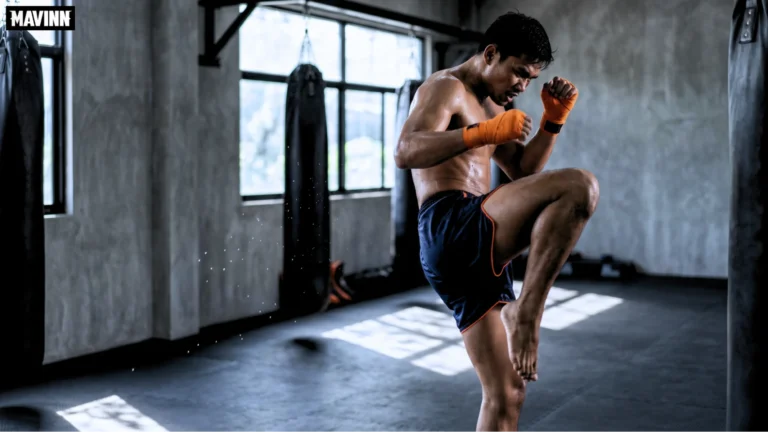
Muay is a Thai combat sport known as the “Art of Eight Limbs,” where you use fists, elbows, knees, and shins for striking. It demands high-intensity movement and peak physical conditioning to handle the impact of all eight contact points. At MAVINN, we structure training around mastering these eight weapons through consistent technical drilling and Bangkok-style pad work.
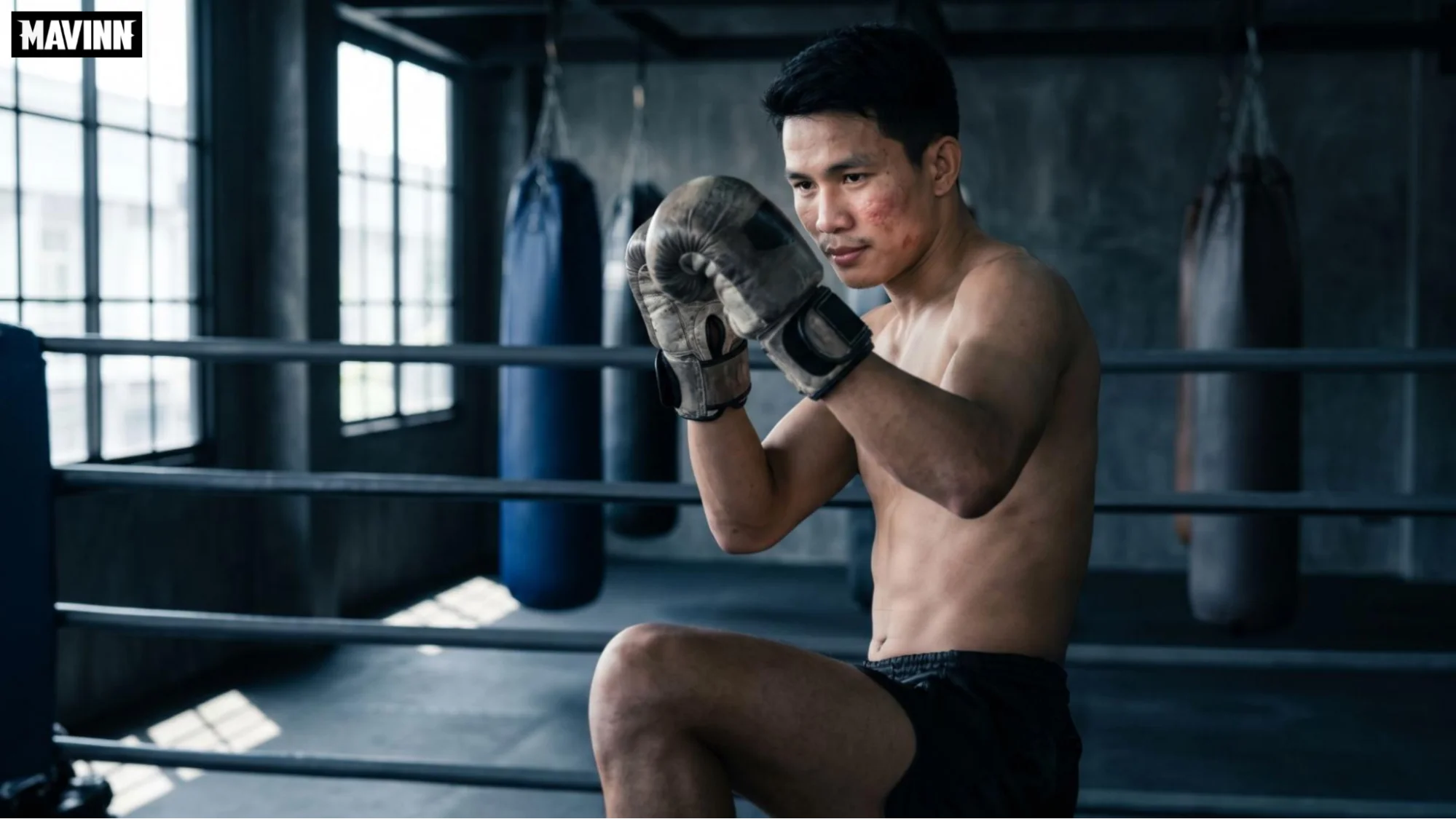
A typical Muay session runs two to three hours of heavy bag work, pad rounds, and clinching, demanding both technical precision and conditioning across every limb. Beginners often underestimate how much grip strength and core stability the clinch phase requires. Mastering the full range of motion for a high-kick takes consistent hip mobility work alongside the striking drills.
What is Muay ? The Origins of Muay Martial Art
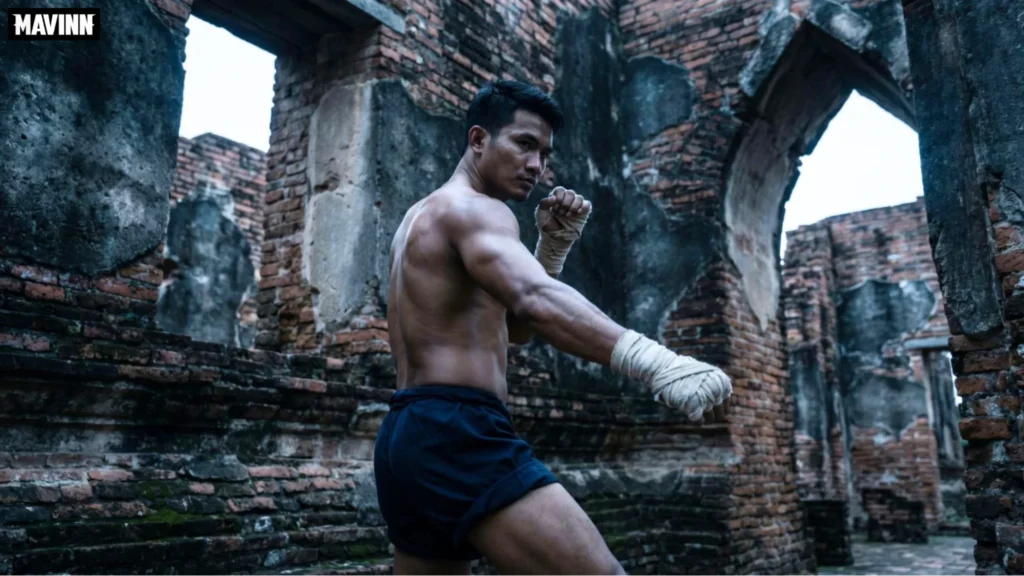
For anyone wondering what muay is exactly, Muay is the Thai term for boxing, representing a centuries-old combat tradition that evolved from ancient battlefield tactics into a global sport. We trace its roots back to the Sukhothai era, where Siamese soldiers mastered these techniques to defend the kingdom when disarmed of their primary weapons. This transition from military necessity to cultural art turned the discipline into a prestigious test of strength showcased at village festivals.
Known globally as the “Art of Eight Limbs,” Muay utilizes your fists, elbows, knees, and shins to create a 360-degree striking system. The discipline evolved from the raw, unrefined style of Muay Boran into the structured professional sport seen in modern stadiums. Formal regulations and safety standards were introduced in the 1920s, replacing traditional hemp rope hand-wraps with the leather boxing gloves used in rings today.
The Evolution From Muay Thai Muay Boran to Modern Thai Boxing
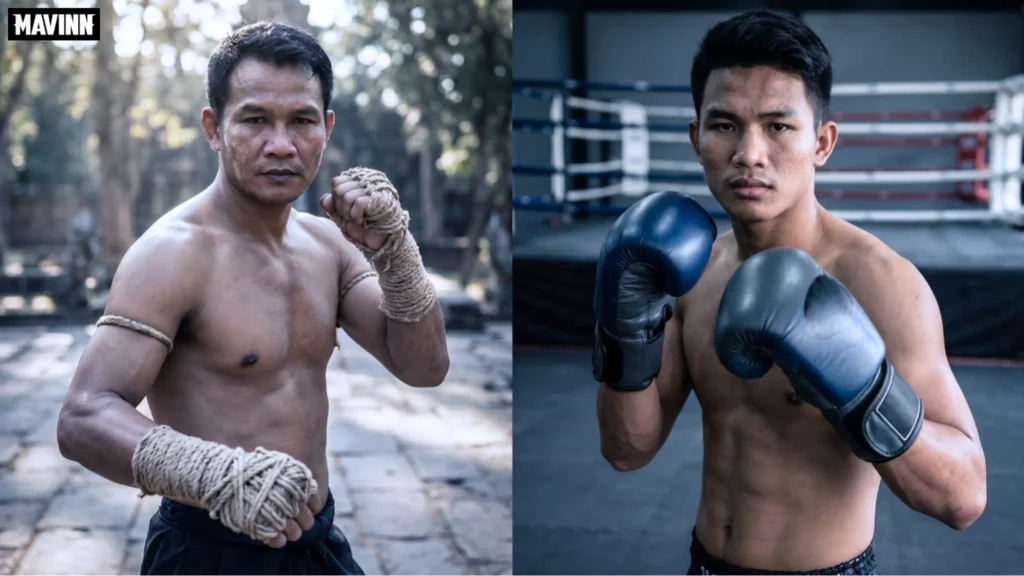
Muay Thai transitioned from a lethal battlefield art known as Muay Boran into a regulated sport during the 1920s to prioritize athlete safety and international appeal. We moved away from raw hemp rope wraps toward padded boxing gloves to reduce severe lacerations and permanent facial trauma. This shift introduced standardized rings and timed rounds, turning a survival-based combat system into a regulated high-performance discipline.
| Feature | Muay Boran (Ancient) | Modern Muay Thai (Sport) |
|---|---|---|
| Hand Protection | Hemp rope wraps (Kard Chuek) | Padded boxing gloves |
| Venue | Dirt pits or temple grounds | Elevated padded rings |
| Ruleset | No weight classes or time limits | Five 3-minute rounds |
Modern practitioners focus on explosive power and technical precision within a framework designed for professional longevity. While ancient styles utilized low stances and headbutts, modern Muay emphasizes an upright posture and refined kicking mechanics. This evolution allows you to train with high intensity while benefiting from the structure of weight classes and modern medical oversight.
The Core Principles Understanding the Eight Limbs of Muay Thai
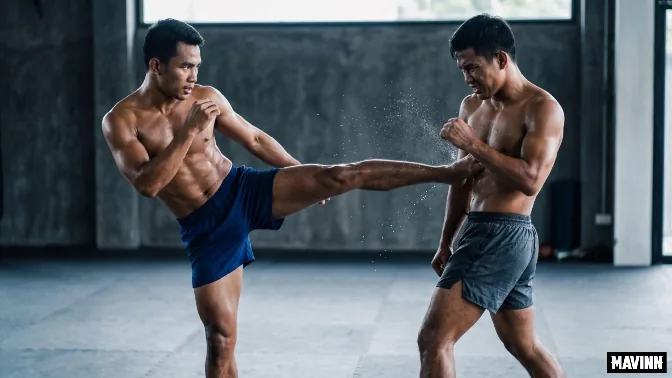
Muay Thai defines itself through the “Art of Eight Limbs,” a system that weaponizes your fists, elbows, knees, and shins. This approach differs from Western boxing or kickboxing by doubling the available striking points, creating a multi-layered offensive strategy. We view these eight points as distinct tools that allow a fighter to remain dangerous at every possible combat distance.
Long-range attacks rely on heavy shins and quick fists, with elite practitioners often landing roundhouse kicks that generate immense kinetic energy against an opponent’s lead leg. As the range decreases, you transition to knees and elbows, which act as high-precision instruments for the clinch and short-range exchanges. Proper execution requires years of specific conditioning to ensure your shins can withstand hundreds of repetitions against heavy bags and Thai pads.
Muay vs. Other Martial Arts How This Thai Boxing Style Differs
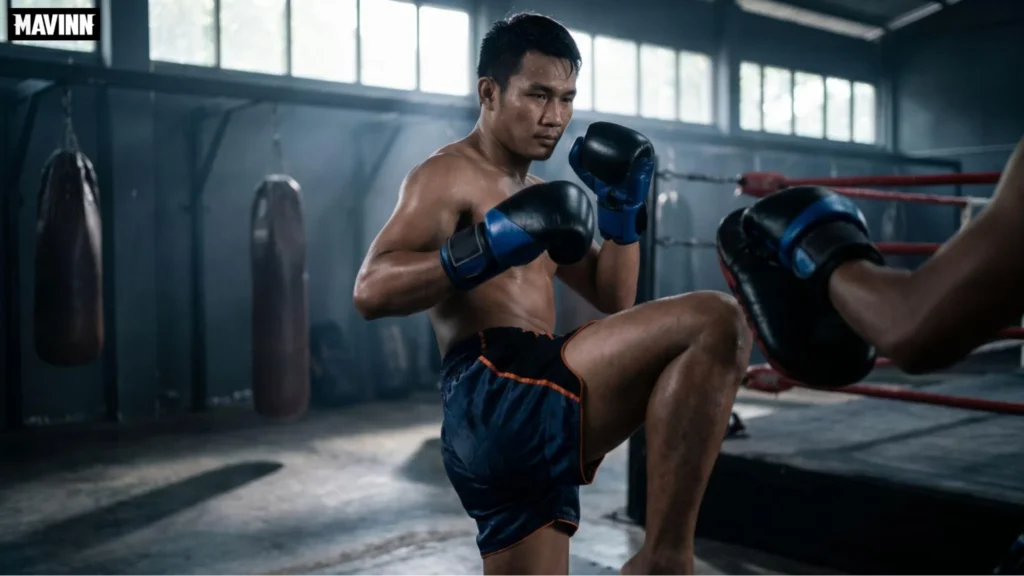
Muay differs from other combat sports by employing eight points of contact—fists, elbows, knees, and shins—creating a complete striking system that dominates at every range. While Western boxing restricts you to punching and Kickboxing often bans elbows, a Nak Muay remains dangerous even in a standing clinch. This versatility transforms the body into a full-scale weapon suitable for both the professional ring and high-intensity street-style training.
| Feature | Muay Thai | Western Boxing | Kickboxing (K-1) |
|---|---|---|---|
| Striking Points | 8 points (Full limb use) | 2 points (Fists only) | 4-6 points (No elbows) |
| Clinch Work | Full grappling & knees | Prohibited by referee | Limited to no clinch |
| Primary Defense | Shin checks & long guards | Head movement & slips | Checked kicks & parries |
We see the major difference in the rhythm; Muay Thai relies on a weighted rhythm that emphasizes timing and heavy singular strikes over the rapid-fire combinations found in Karate. The stance is taller and more squared, allowing you to check leg kicks instantly, a mechanic rarely practiced in traditional Kung Fu or Taekwondo. Mastering these mechanics requires consistent shin conditioning and the patience to drill the same footwork pattern thousands of times.
Muay Thai vs. Kickboxing and Karate
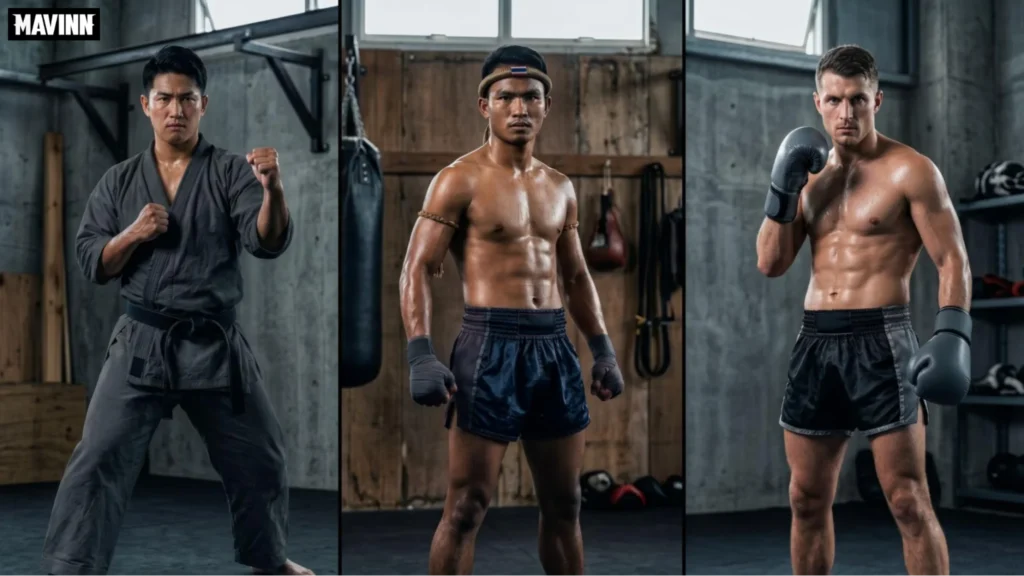
Muay Thai stands apart from Kickboxing and Karate by integrating elbows and advanced neck wrestling into a high-impact striking system. While Kickboxing focuses on rapid-fire boxing combinations and Karate prioritizes linear explosive speed, Muay practitioners favor “damage over volume” to break opponents down. You will notice the stance is significantly taller and more squared to allow for immediate shin checks against low kicks.
The rhythm of a Thai fight is deliberate, often starting slower to find the range before landing heavy singular strikes. Karate relies on “bladed” stances for quick entries and exits, whereas modern Kickboxing removes the clinch to prioritize mid-range punching exchanges. The full-body impact of a heavy Muay Thai roundhouse can generate force on the order of 2,000 newtons against the target.
| Feature | Muay Thai | Kickboxing (K-1/Glory) | Karate (Traditional) |
|---|---|---|---|
| Weapons | 8 limbs (incl. elbows) | 4-6 limbs (no elbows) | Fists and feet only |
| The Clinch | Full grappling & knees | Limited to 5 seconds | Not permitted |
| Rhythm | Heavy, weighted strikes | High-volume combinations | Explosive in-and-out speed |
| Main Defense | Shin checks & long guard | Head movement & parries | Distance & footwork |
Why Practice Thai Boxing ? Physical and Mental Benefits
Muay Thai transforms your body into a high-performance machine by utilizing the “Art of Eight Limbs” to engage every major muscle group simultaneously. You build functional strength and explosive power because every strike originates from core stabilization and hip rotation. A standard 60-minute session typically burns between 600 and 1,000 calories, making it one of the most efficient fat-loss tools in combat sports.
Beyond the physical gains, training sharpens your mental grit by forcing you to maintain composure under extreme physical exertion. This constant exposure to high-pressure scenarios lowers resting cortisol levels and improves your overall cognitive focus. You gain a deep sense of confidence that carries over into your daily life and professional challenges.
- Increased bone density in the shins and forearms from repetitive bag work.
- Improved cardiovascular health through high-intensity interval training (HIIT) structures.
- Enhanced hip mobility and flexibility required for executing high roundhouse kicks.
- Developed lightning-fast reflexes and hand-eye coordination during defensive drills.
What to Expect in Your First Thai Box Class
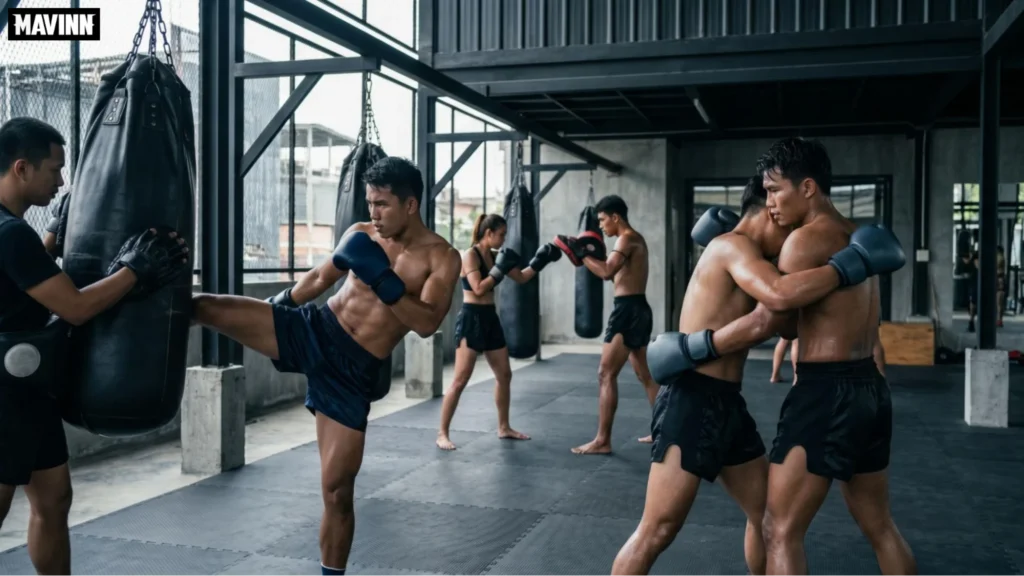
Your first Muay Thai session focuses on fundamental body mechanics and high-intensity conditioning rather than immediate sparring. You will likely start with a 15-minute warm-up involving jump rope and dynamic stretching to prepare your joints for repetitive impact. Instructors then guide you through the basic stance and “long guard” to ensure your balance remains stable during heavy hip rotation.
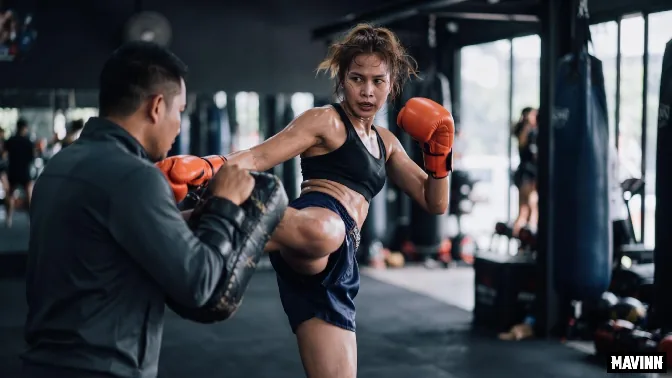
Expect to spend the majority of the hour on heavy bags or hitting Thai pads held by a partner to build striking accuracy. We emphasize landing with the lower third of the shin bone to maximize force while protecting the fragile bones in your feet. Most beginners finish the session with 30 to 50 reps of clinch knees and teeps to develop the core endurance required for a full round.
The class concludes with a burnout set of bodyweight exercises to test your mental grit under extreme physical fatigue. You will leave the gym with a clear understanding of how to generate power from the ground up through your kinetic chain. Bring a dedicated 1.5-liter water bottle and hand wraps to protect your knuckles from repetitive bag friction.
Essential Gear What to Wear for Muay Thai
You need high-cut satin shorts and professional-grade hand wraps to ensure full mobility and wrist stability during every Muay session. Standard athletic shorts often snag during high kicks, whereas Muay Thai-specific cuts feature wide leg openings and side slits for a 180-degree range of motion. We recommend using 180-inch semi-elastic wraps to fully secure the 27 small bones in your hand against impact.
- 12oz to 14oz gloves for a versatile balance of hand protection and striking speed.
- Impact-resistant shin guards to shield your tibia and instep during heavy kicking drills.
- Moisture-wicking rash guards or performance tees to manage sweat and prevent skin abrasions.
Choosing the right glove weight is critical; use 10oz for pad work and 16oz for sparring to ensure the safety of your training partners. Leather gear offers the best long-term durability, but modern synthetic options provide a lightweight feel for high-intensity cardio rounds. Ensure your shin guards cover the entire area from just below the knee to the top of the foot for maximum coverage.
How to Wrap Hands Correctly for Muay Safety
Proper hand wrapping for Muay Thai requires securing the wrist, thumb, and knuckles with consistent tension to stabilize the small bones during impact. You should use a 180-inch semi-elastic wrap to ensure enough material for a dedicated knuckle pad and multiple wrist rotations. If your fingers tingle or turn blue, the wrap is too tight and requires immediate adjustment to restore blood flow.
1. Loop the thumb and wrap the wrist three times to create a rigid foundation.
2. Cross the back of the hand to wrap the knuckles three times for impact protection.
3. Run the wrap between each finger to lock the padding and secure the thumb joint.
4. Finish by wrapping the remaining material around the wrist and fastening the velcro snugly.
Make a fist to ensure the wrap tightens over the knuckles while remaining comfortable across the palm. Professional practitioners often focus on extra wrist revolutions to support the joint against the high-torque forces of clinching and elbow strikes.
Essential Tips for Muay Beginners (Toi Muay)
Mastering your stance and basic footwork is the absolute first step for any beginner starting their Muay journey. Focus on keeping your weight balanced between both legs to ensure you can transition quickly from offense to defense. Proper form prevents common injuries, such as rolled ankles, which often occur when students cross their feet during lateral movement.
Before hitting the gym, you should secure high-quality gear that stands up to the rigors of heavy combat training:
- 180-inch hand wraps to stabilize the wrist and protect the 27 small bones in your hand.
- 12oz to 14oz gloves for a balance of protection and speed during bag work.
- High-slit shorts that provide the necessary range of motion for landing roundhouse kicks.
Conditioning your shins and lungs is a gradual process that requires patience and repetitive heavy bag drills. Exhale sharply every time you strike to engage your core and manage your oxygen levels effectively. This rhythmic breathing is the key to maintaining power throughout a standard three-minute round of intense pad work.
Muay FAQs Answers About Mui Ty, Muha Thai, and More
Are terms like Mui Ty, Muha Thai, or muaytahi correct?
Muay Thai is the correct spelling for the “Art of Eight Limbs,” while terms like Mui Ty or Muha Thai are phonetic misspellings or regional transliterations. These variations typically arise when international fans attempt to spell the Thai word based on phonetic sounds in their native languages.
We also frequently see keyboard typos like muaytahi or redundant search phrases like muay muay thai from the global community. Regardless of how it is typed into a search engine, all of these variations connect you to the exact same high-impact striking discipline found in professional stadiums.
Is Muay Thai the Most Powerful Martial Art ?
Muay Thai is widely considered the most powerful striking art because it utilizes the Science of Eight Limbs to generate unmatched force. Unlike combat sports that limit you to two or four striking points, we focus on fists, elbows, knees, and shins to attack from every angle. A seasoned fighter’s roundhouse kick can register over 1,200 pounds of force, which is enough to crack a baseball bat or a competitor’s ribs.
This power stems from biomechanical efficiency, where every strike uses the entire body’s weight rather than just limb strength. You learn to pivot your lead foot and swing your hip through the target, treating your shin like a heavy iron bar. This ruthless efficiency is why Muay Thai has become one of the dominant striking foundations for professional MMA fighters across major promotions including the UFC.
Is Thai Boxing Good for Self Defense ?
Muay Thai is one of the most effective martial arts for self-defense because it teaches you to use your entire body as a functional weapon. Unlike standard boxing, you utilize eight points of contact including your fists, elbows, knees, and shins. This structural versatility allows you to neutralize threats at multiple ranges, whether you are striking from a distance or caught in a tight, stand-up clinch.
The conditioning involved in this training builds the explosive power and cardiovascular endurance needed to survive a high-stress physical confrontation. You learn to deliver heavy low kicks that can instantly deaden an attacker’s leg and compromise their ability to move or strike. Consistent sparring ensures you are acclimated to physical impact and pressure, which are the two most critical factors for surviving a real-world encounter.
What Punching Bags Are Used for Muay ?
You need bags that accommodate the full range of the “Art of Eight Limbs,” specifically the 6-foot banana bag and the teardrop bag. The banana bag is the primary tool because its length lets you transition from head kicks to calf strikes instantly, making it perfect for shin conditioning. We suggest leather or high-grade synthetic shells hung just above the floor to allow for realistic leg sweeps, while using bags weighing 100 to 150 pounds to prevent excessive swinging during power strikes.
Teardrop bags utilize a tapered shape that is essential for practicing spear knees and clinching. This angled surface allows your knee to penetrate the target rather than glancing off a flat cylinder, unlike standard boxing bags. To complement these, many elite gyms also incorporate wall-mounted units to sharpen the precision of close-range elbows.
Conclusion
Muay serves as a complete combat system that weaponizes the fists, elbows, knees, and shins to create a 360-degree striking framework. Training in this “Art of Eight Limbs” demands consistent practice across all eight weapons, often through two to three hour sessions of heavy bag work, pad rounds, and clinching. Building this skill set takes patient repetition under expert guidance to ensure clean technical form from day one.
Protecting your joints requires the right basics like 180-inch semi-elastic hand wraps and well-padded gloves to handle repetitive impact. Consistent practice on 6-foot banana bags conditions your shins to deliver roundhouse kicks with the kind of force documented in striking research (over 1,000 pounds at the elite level). This discipline transforms your physical baseline, building functional strength and mental grit that carries over into every aspect of your daily life.