Key Takeaways
- Muay Thai Knee Kick – This strike delivers devastating power in close-range combat by driving the hip forward and maintaining a tight guard.
- Proper execution relies on balancing on the ball of the supporting foot while pulling the opponent’s guard down to create an open target.
- Regular practice of this strike builds functional core strength, hip mobility, and cardiovascular endurance.
- Systematic training through focused pad work and sparring drills helps fighters of all levels integrate this weapon into their offensive arsenal.
The Muay Thai Knee Kick is one of the most destructive strikes in combat sports, delivering maximum force by channeling your entire body weight through the patella. This weapon pierces an opponent’s guard to target the ribs, liver, and solar plexus. Firing a powerful knee requires a synchronized 45-degree hip drive to maximize impact.
Mastering this strike transforms your close-range game, especially when fighting inside the clinch. It runs on the same hip mechanics covered in our Muay Thai technique guide. We train fighters at Mavinn Muaythai to set up these strikes using hand traps that open up the opponent’s guard, which builds directly on the Thai clinch control covered in our clinch guide. This system ensures you maintain your defensive posture while executing the strike.
Defining the Evolution of the Muay Thai Knee Kick
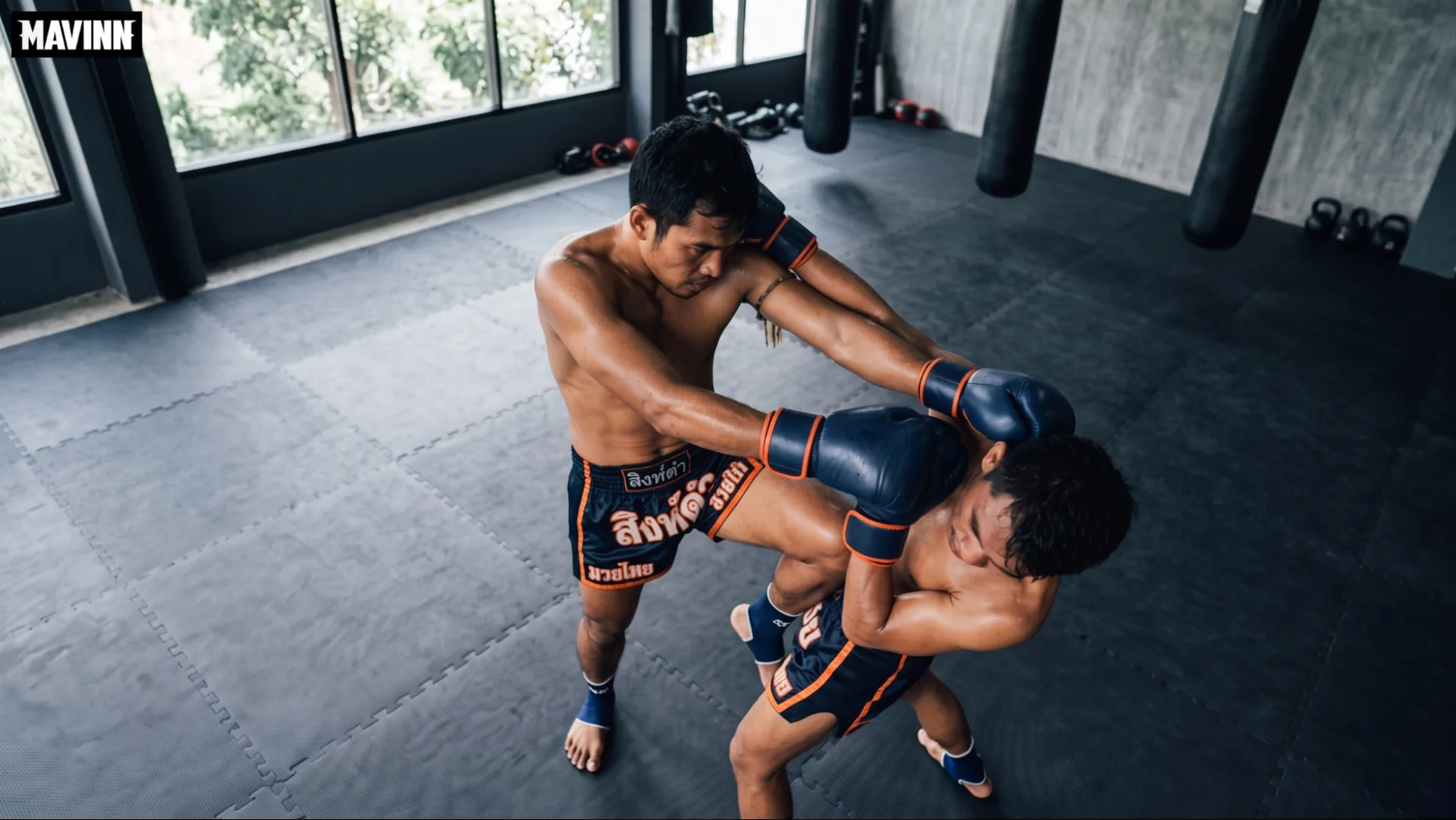
The Muay Thai knee kick evolved from a lethal battlefield survival tool into a highly refined ring tactic designed for maximum damage under modern sport rules. Ancient warriors used these strikes to pierce armor and disable opponents during combat. Today, fighters adapt these movements to bypass 10-ounce boxing gloves and score high points under Lumpinee Stadium judging criteria.
| Era | Primary Target | Technical Focus |
|---|---|---|
| Ancient Muay Boran | Vital organs, throat, and joints | Lethal damage and self-defense |
| Modern Muay Thai | Ribs, solar plexus, and thighs | Speed, hip rotation, and ring control |
We categorize this evolution into distinct tactical shifts that define how fighters use their joints. Modern training prioritizes 45-degree hip extension to maximize the reach of each strike. This structural shift allows fighters to land clean blows from up to three feet away.
The “Lost Strikes” of Ancient Muay Thai (Muay Boran)
Ancient Muay Thai knee strikes, known as Muay Boran knees, prioritized battlefield lethality over sport scoring. These historic techniques targeted vital areas like the throat, groin, and spine to neutralize armed enemies. For example, warriors used the Hak Kho Chang technique to pull an opponent’s head down directly into a rising knee strike.
Acrobatic leaps and ground combat defined these ancient styles before modern safety rules emerged in 1929. Fighters frequently launched themselves off an opponent’s thigh to deliver downward strikes to the skull. This high-risk maneuver, called Khao Loi, highlights how ancient warriors weaponized their entire body weight.
Adapting Knee Strikes for Modern Ring Combat
Modern ring combat requires you to adapt traditional knee strikes into faster, more direct weapons to score points under strict referee supervision. Ancient styles favored high-risk jumping moves designed for battlefield lethality. Today, fighters prioritize short, explosive thrusts like the straight knee (Khao Trong) to pierce the opponent’s guard without exposing their own balance.
To survive in the modern ring, you must combine your Muay Thai knee kick with tight glove defense to block counter punches. Fighters now use the clinch to pull the opponent’s head down directly into the rising knee. This shift means modern fighters devote a large share of their training to hand placement and posture control, because that is what creates the opening for a scoring knee.
What Makes Muay Thai Knee Strikes So Devastating ?
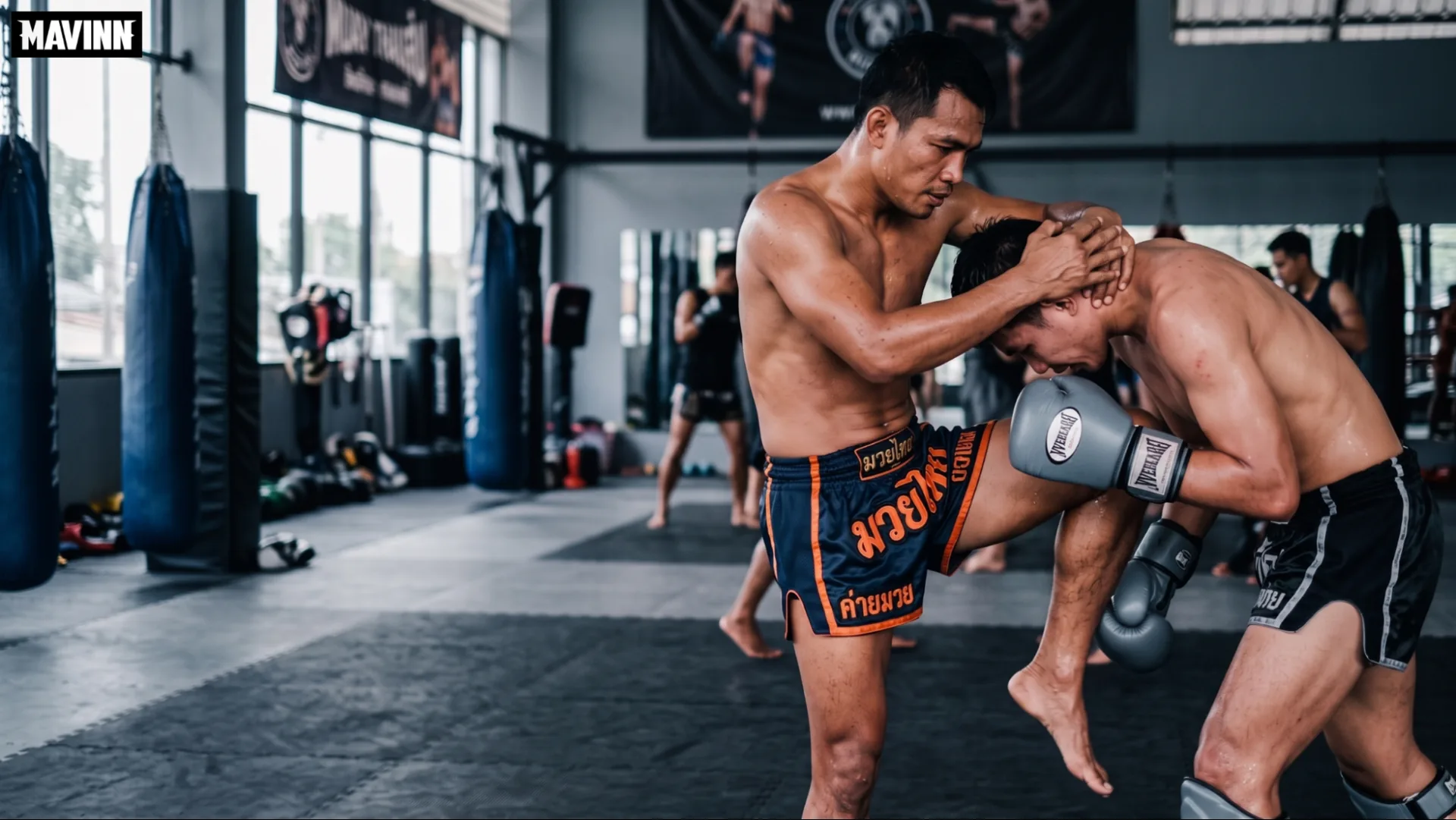
Muay Thai knee strikes derive their devastating power from channeling your entire body mass through the sharpest point of the patella. Unlike punches, a knee strike engages the massive muscle groups of your hips, core, and glutes to drive the impact forward. A properly executed straight knee concentrates that mass into a small, hard contact point, which is why clean knees crack ribs and end fights.
The damage increases significantly because you use the clinch to pull your opponent directly into the oncoming strike. This collision of opposing forces doubles the impact velocity without requiring extra energy from the attacker. To maximize this effect, pull your opponent’s crown down while simultaneously driving your hip forward at a 45-degree upward angle.
The Basic Mechanics and Types of Muay Thai Knees
A powerful Muay Thai knee kick relies on driving your hips forward while pivoting on your standing foot to thrust the sharpest part of your kneecap into the target. This mechanical chain converts your lower body mass into concentrated kinetic energy that can easily break an opponent’s guard. For maximum power, extend your ankle and point your toes downward to harden the striking surface of your knee.
We categorize these strikes into distinct types based on your distance from the opponent. The straight knee, or Khao Trong, drives directly forward into the solar plexus. The curving knee, known as Khao Khong, arches sideways to puncture the floating ribs during close-range clinch work. Practitioners must maintain a high guard on the striking side, keeping the opposite hand active to block counter-punches.
How to Generate Maximum Power in Your Muay Thai Knees
You generate maximum power in a Muay Thai knee kick by driving your hips forward and elevating onto the ball of your supporting foot. This movement transforms your body weight into forward momentum rather than just lifting your leg upward. Engaging your core and swinging the arm on the striking side down helps rotate your torso, which noticeably increases the speed of the strike.
Keeping your defensive guard up protects your chin from counter-elbows while you execute the strike. Pivoting the standing foot outward at a 45-degree angle opens your hips and allows for a deeper thrust. Keep the toes of your striking foot pointed downward to sharpen the kneecap and focus all kinetic energy into a single impact point.
Driving Your Hips and Extending on Your Toes
You generate maximum power in a Muay Thai knee kick by thrusting your hips forward while exploding upward on the toes of your supporting foot. This extension elevates your center of gravity, converting your body weight into forward momentum. Failing to drive the hip limits the strike to a weak, upward leg lift that rarely damages an opponent.
To execute this correctly, lean your upper body back slightly as a counterbalance and swing the arm on your striking side downward. This counter-movement pulls your hip forward, forcing your knee to penetrate deep into the target rather than just grazing the surface. For maximum impact, aim to extend your ankle fully, raising your heel at least 2 to 3 inches off the canvas.
Common Mistakes That Ruin Your Knee Power
Dropping your hands and leaning backward incorrectly are the primary mistakes that destroy the power and defense of your Muay Thai knee kick. These errors leave you vulnerable to counter-attacks and limit your reach. Avoid these three critical mistakes during training.
- Dropping your guard: Flaring your lead arm down exposes your chin to counter punches like a left hook. Keep your non-striking hand glued to your temple to maintain a secure guard.
- Flat-footed execution: Failing to drive upward on the ball of your supporting foot cuts your striking reach by 3 to 4 inches. Pivot your standing foot to force your hips forward.
- Bending the knee loosely: A floppy leg cushions the blow instead of piercing the target. Pull your heel tight against your hamstring to create a hard, sharp striking surface.
Smart Setups to Land Your Muay Thai Knee Kick Every Time
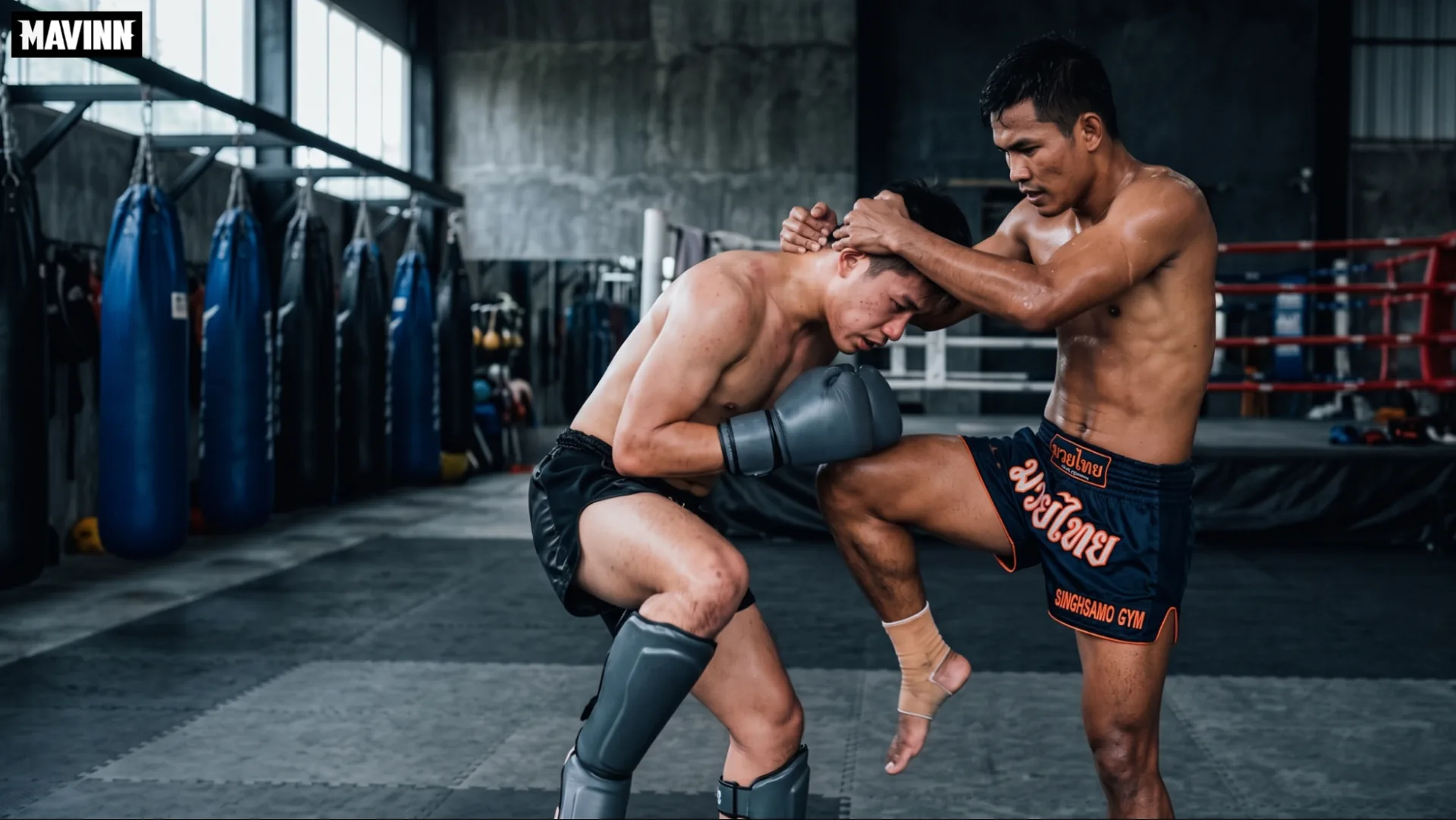
You land a devastating Muay Thai knee kick by hiding the strike behind punching combinations or by physically controlling your opponent’s upper body. Throwing a knee without a setup leaves you open to easy sweeps and dominant counter strikes. A classic setup involves throwing a jab-cross-hook combination to force your opponent to raise their guard, exposing their midsection for a straight knee.
Another highly effective setup utilizes the lead teep to establish distance before switching your rhythm. Once your opponent expects the foot thrust, you fake the teep, step forward, and drive the rear knee into the ribs. In close quarters, you must control the neck to break their spine alignment, creating a 45-degree angle that opens up the liver for a piercing knee strike.
Setting Up the Strike with Punches and Teeps
You land a Muay Thai knee kick by distracting your opponent with punches and teeps that force their guard up or disrupt their balance. Blinding their vision or shifting their center of gravity opens clear pathways directly to the midsection. Use these precise tactical setups to guarantee your strike connects.
- The Jab-Cross-Hook Blind: Throw a quick three-punch combination to force your opponent’s hands high, leaving their ribs exposed.
- The Fake Teep Entry: Lift your lead leg to mimic a front kick, forcing your opponent to drop their guard before you drive your rear knee forward.
- The Cross-to-Knee Bridge: Land a heavy straight right punch to pin your opponent in place, transitioning instantly into a penetrating knee strike.
Clinch Control and Breaking Your Opponent’s Posture
You land devastating Muay Thai knee kicks by securing dominant hand placement in the clinch to break your opponent’s posture. Controlling the back of your opponent’s head allows you to manipulate their spine and limit their defensive movement. Once their head is pulled down, their hips push backward, exposing their midsection to your oncoming knee strikes. Follow these key steps to break their posture effectively.
- Lock your hands behind the crown of their head rather than the neck to maximize your mechanical leverage.
- Pull their head downward toward your collarbone while keeping your elbows tucked tight against their chest.
- Turn your shoulders to steer their upper body, forcing them to step and lose their balance.
This control creates a clear path for a 90-degree Muay Thai knee strike directly into the ribs or solar plexus.
Professional Rules and Scoring for Muay Thai Knee Strikes
Professional Muay Thai judges award the highest points to knee strikes that land cleanly on the opponent’s torso and cause visible physical damage or off-balancing. You must show dominance and control during the strike, especially when executing knees from the clinch position. Under standard stadium rules, a soft knee that merely touches the opponent without force receives zero points.
Legal target areas for the Muay Thai knee kick include the entire midsection, the ribs, and the thighs, while direct strikes to the groin are strictly prohibited. Our full guide to the rules of Muay Thai covers the fouls, deductions, and recovery time in detail. Scoring criteria also favor fighters who use knee strikes to break their opponent’s posture, pulling their head down to meet the rising joint.
Legal Requirements and Judging Criteria on the Standard Stage
Judges score a Muay Thai knee kick based on visible impact, damage, and clean execution rather than the sheer volume of strikes thrown. In professional stadiums, a knee strike must land cleanly on the opponent’s torso or head without being blocked to score points. If you throw a knee that merely hits your opponent’s defensive guard, the judges will award zero points for that exchange.
Standard rules strictly prohibit striking the groin with any knee technique, which can result in an immediate point deduction or disqualification. You must also maintain active offense during clinch situations, as roughly three seconds of inactivity will prompt the referee to break the clinch. Showing dominant physical control while landing clean knees is the most effective way to secure a winning scorecard under official WMC regulations.
Level Up Your Muay Thai Knees at Mavinn Muaythai
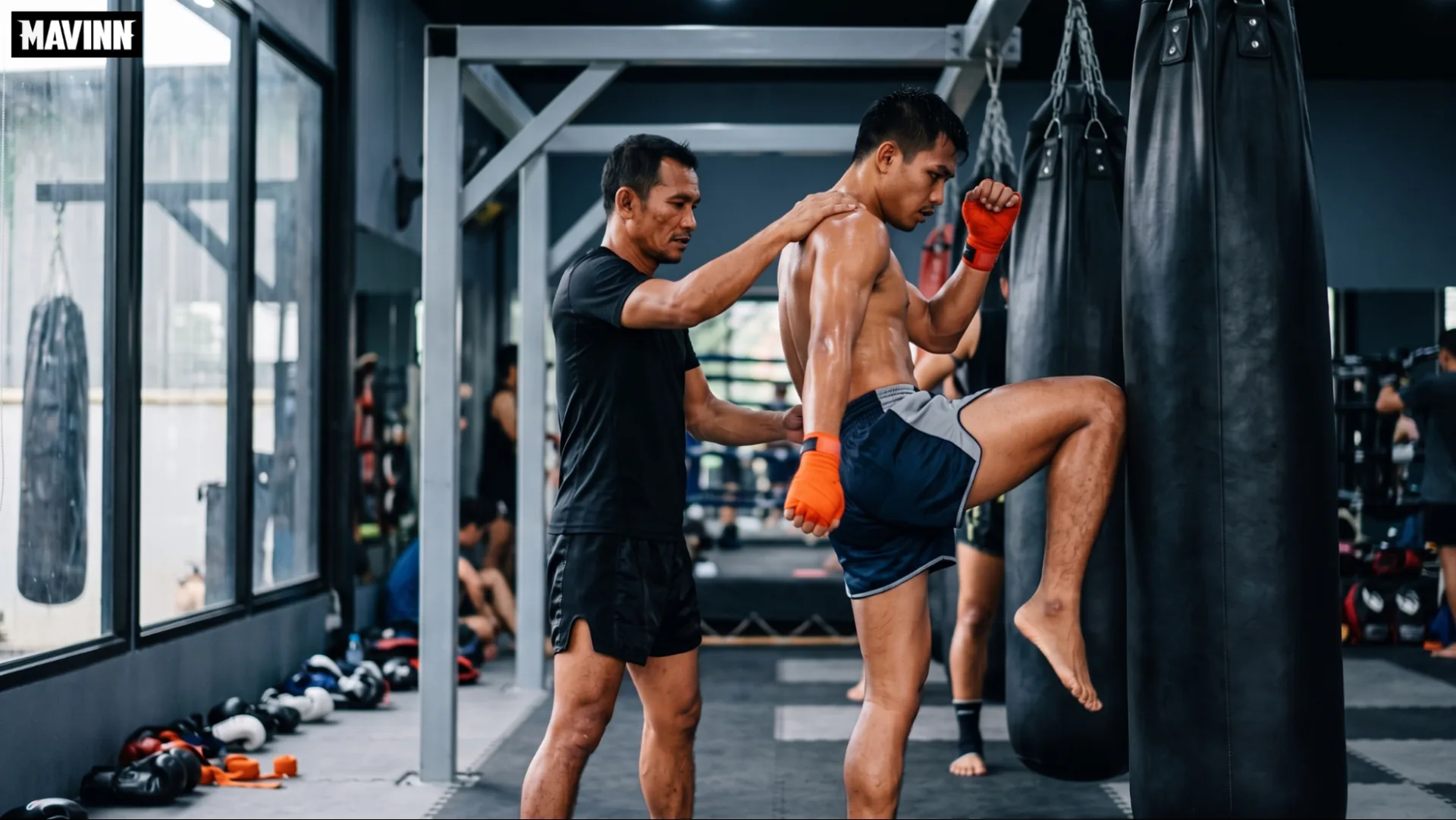
You will master the Muay Thai knee kick through structured, fighter-led training programs designed for all skill levels. Your training is guided by elite instructors, including world-class striking specialist and reigning ONE Featherweight Kickboxing World Champion Superbon Singha Mavinn. Our curriculum focuses on heavy bag drills and intensive clinch sparring to build real power and precision.
Our specialized programs are available at our Bangkok gym in Nuanchan and our Pattaya gym. You can choose from flexible options to match your goals, including online courses and our dedicated Stay & Train package. These programs ensure you develop the specific hip rotation and balance needed to land devastating knee strikes in any sparring scenario.
Heavy Bag and Clinch Sparring Drills with Pro Trainers
We build devastating knee power and perfect timing by combining structured heavy bag routines with active clinch work under the eyes of professional trainers. If you have never sparred before, read what sparring actually involves first. This dual approach ensures you learn to deliver the Muay Thai knee kick with maximum force while maintaining your balance against a resisting opponent. Our trainers prescribe 50 continuous knee strikes per bag session to build hip endurance. Our curriculum focuses on two primary drills to sharpen your skills.
- Continuous Bag Burnouts: You drive consecutive knees into a heavy bag for three-minute rounds to develop hip flexion stamina.
- Posture Control Sparring: You work with a partner to break their neck posture using a collar tie before landing a controlled knee to the ribs.
Working directly with experienced trainers helps you correct balance errors before they become bad habits. Coaches physically adjust your shoulder positioning and hip rotation during live clinch exchanges to prevent counter-strikes. Keeping sparring groups small is what makes that level of correction possible.
Customized Training Packages at Our Bangkok and Pattaya Gyms
We offer flexible Stay & Train packages designed to fit your fighting goals at our Bangkok (Nuanchan) and Pattaya gyms. You can choose from daily group classes, online courses, or a Stay and Train block that focuses on sharpening specific weapons like the Muay Thai knee kick. Every training program gives you direct access to world-class coaching, including specialized curriculum elements developed by Superbon Singha Mavinn.
| Package Option | Best For | Included Features |
|---|---|---|
| Stay & Train | Active travelers | Multi-day block of intensive daily training |
| Group Classes | Technical refinement | Pad work, bag work, clinch and knee drills |
| Online Courses | Remote learning | Video tutorials, fight analysis, mobility guides |
Our trainers customize every session to match your current fitness level and combat experience. You will practice setups, heavy bag drills, and live clinch work to make your strikes highly functional. Beginners can start with basic stance work, while advanced fighters can book intensive sparring sessions directly at our Nuanchan branch.
FAQs Muay Thai Knees
How do ancient Muay Thai knees differ from modern ring strikes ?
Ancient Muay Thai knee strikes targeted lethal, unprotected areas like the throat and temple, whereas modern ring strikes focus on scoring points and securing knockouts within strict sport rules. Ancient combat used rope-bound fists and allowed ground fighting, meaning knees were thrown to crush a fallen opponent. Today, fighters wear padded gloves and must deliver the Muay Thai knee kick while standing, often using the clinch to control the neck. We train fighters to adapt these traditional hip-driving mechanics for maximum power under modern unified rules.
| Feature | Ancient Muay Thai (Muay Boran) | Modern Ring Strikes |
|---|---|---|
| Primary Targets | Throat, groin, spine, and joints | Ribs, sternum, thighs, and head |
| Hand Wear | Hemp rope bindings | Padded 8oz to 10oz boxing gloves |
| Ruleset | No weight classes or time limits | Five 3-minute rounds with referee breaks |
Can beginners start learning the jumping knee right away ?
Beginners should not attempt the jumping Muay Thai knee kick right away because it requires advanced balance, timing, and hip flexibility. You must first master the basic ground-based Muay Thai knee kick to build the necessary hip drive and core strength. Attempting mid-air strikes prematurely often leads to severe ankle sprains or knee hyperextension upon landing.
We recommend training the standard straight knee for at least 3 to 6 months before adding the jump. Focus your initial training sessions on shadowboxing and heavy bag drills to perfect your launch posture. Once you can consistently drive your hips forward while maintaining a stable single-leg stance, you can safely transition to plyometric jump boxes to build explosive power.
Read next: How to Learn Muay Thai for Complete Beginners
How can I maintain my balance if I miss a knee strike ?
You maintain your balance after a missed Muay Thai knee kick by immediately dropping your striking foot straight down to the floor instead of swinging it forward. Letting your foot drift forward ruins your stance and leaves you open to sweeps. Keep your core tight and pull your hips back to your original fighting stance instantly. To recover quickly, focus on these three physical adjustments.
- Drop the foot vertically: Pull your heel straight down to the mat to land on the ball of your foot.
- Keep your guard high: Maintain your defensive posture with your lead hand extended to block counters.
- Flex your standing leg: Keep a slight 10-degree bend in your support knee to absorb sudden shifts in weight.
Conclusion
The Muay Thai Knee Kick is a devastating, close-range weapon that transforms your offensive game when executed with correct hip drive and balance. Mastering this strike requires a commitment to proper mechanics, including driving your hips forward and maintaining a tight defensive guard. We help you develop this power through structured training programs that translate directly to ring success.
Our professional training packages at Mavinn Muaythai provide the direct coaching you need to perfect these complex striking systems. You can train alongside elite specialists like Superbon Singha Mavinn at our Nuanchan branch in Bangkok or our Pattaya gym. Choose our specialized Stay & Train package or join our online courses today to start building a highly functional, dangerous knee strike.