Key Takeaways
- How to learn muay thai Master the fundamental stances, footwork, and basic strikes through structured training programs designed for all skill levels.
- Flexible training options allow you to practice through interactive online courses or commit fully with immersive Stay & Train packages.
- Training under professional instructors, including reigning ONE Featherweight Kickboxing World Champion Superbon Singha Mavinn, ensures you build correct technique and combat habits.
- Physical camps in Bangkok and Pattaya provide hands-on coaching to help you reach your personal fitness or competitive goals.
You can master how to learn muay thai effectively by combining structured shadowboxing, heavy bag drills, and supervised pad work. This systematic training builds your muscle memory and cardiovascular endurance while teaching you the proper mechanics of the “Art of Eight Limbs.” Beginners should execute 100 perfect mid-kicks daily to establish solid hip rotation.
We accelerate your progress through hybrid training, offering online video modules and on-site sessions at our Bangkok and Pattaya gyms. You will train under elite specialists, including reigning ONE Featherweight Kickboxing World Champion Superbon Singha Mavinn, to ensure flawless technique.
What is Muay Thai training and why should you start ?
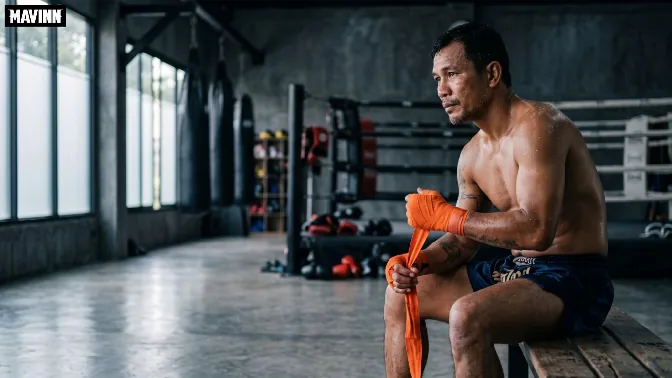
To understand how to learn muay thai, you must view it as a full-body conditioning system that weaponizes your fists, elbows, knees, and shins. This martial art builds functional strength, sharpens your reflexes, and teaches practical self-defense techniques. A single session of this high-intensity training can burn up to 800 calories.
You should start this journey because it builds mental resilience and discipline that carries over into your daily life. The repetitive striking drills forge bone density and core stability, making your body highly resistant to injury. We recommend starting with three weekly sessions to allow proper muscle recovery while building consistent muscle memory.
Understanding the art of eight limbs
To learn Muay Thai effectively, you must master the “Art of Eight Limbs,” which transforms your entire body into a weapon by utilizing eight distinct points of contact instead of just two. Unlike traditional kickboxing, this combat system coordinates your fists, elbows, knees, and shins to attack and defend from any angle. To develop this coordination, we train you to strike in fluid combinations, transitioning from a long-range kick to a close-quarter elbow strike.
Each limb serves a specific tactical purpose on the mats. For instance, you use your shins for heavy roundhouse kicks to damage an opponent’s thighs, while your elbows act as short-range blades during clinch fighting. Mastering these weapons requires consistent drilling of stance, balance, and hip rotation to generate maximum power.
Physical and mental benefits of getting into Muay Thai
Training in Muay Thai builds elite cardiovascular endurance, burns up to 1,000 calories per hour, and sharpens your mental focus under pressure. When you discover how to learn muay thai, you develop full-body power by engaging your core, shoulders, and hips through rotational striking. This constant physical conditioning stimulates endorphin release, which actively lowers your daily stress levels.
The training delivers distinct advantages for both your body and mind:
- Cardiovascular Conditioning: High-intensity interval output strengthens your heart and increases lung capacity.
- Mental Resilience: Sparring and pad work train your brain to remain calm in high-stress situations.
- Functional Strength: Kicking and clinching build core stability and hip mobility.
We structure our programs to ensure you build these attributes safely from your very first session. Our training regimens, developed alongside world-class specialists like Superbon Singha Mavinn, combine traditional conditioning with modern athletic science to maximize your physical output.
Building your Muay Thai fundamentals at home
You can develop real conditioning and drill the fundamental strikes at home, but you cannot correct your own technique without live feedback. Treat solo work like shadowboxing and heavy-bag drills as preparation, not a replacement for coaching. Shadowbox in front of a mirror to catch stance errors before they turn into habits, and follow structured video instruction rather than guessing the movements.
For the full picture on training without a partner, read whether you can learn Muay Thai at home.
Muay Thai 101 Mastering the Muay Thai fundamentals
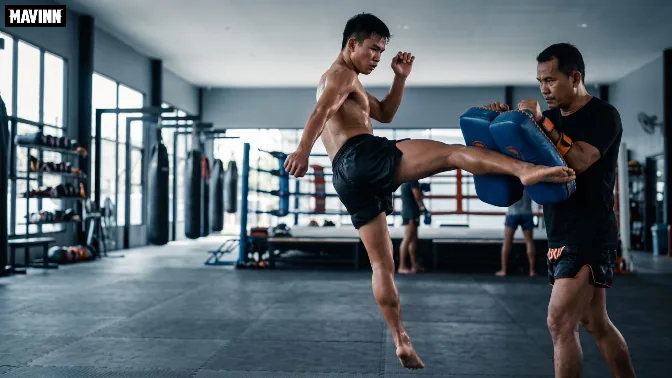
Learning how to learn Muay Thai begins with mastering your fighting stance, guard, and basic footwork. A solid foundation prevents injuries and generates maximum power behind every punch, kick, knee, and elbow. For instance, keeping your weight distributed 50/50 between your feet allows you to transition instantly from defense to offense.
We structure our training programs to focus on these core mechanics through repetitive, deliberate practice. You will learn to throw a basic roundhouse kick by rotating your hips and pivoting on the ball of your support foot. Practicing this motion 100 times per session builds the muscle memory required to execute strikes with speed and balance.
Defensive fundamentals like checking kicks and slipping punches are just as vital as offensive strikes. Under the guidance of our world-class striking specialist Superbon Singha Mavinn, you will drill these reactions until they become instinctive. Focus on keeping your hands high and your chin tucked to protect your jaw during sparring drills.
Finding your Muay Thai stance and defensive guard
Your Muay Thai stance must balance offensive mobility with defensive stability, starting with your feet positioned shoulder-width apart and your dominant leg stepped back. For an orthodox fighter, this means stepping your right foot back at a 45-degree angle. Keep your weight distributed 50/50 between both feet, allowing you to light-check incoming kicks instantly. To set your defensive guard, follow these three steps:
- Raise your hands to eyebrow level with your palms facing forward.
- Keep your elbows tucked in to protect your ribs.
- Tuck your chin down to shield your jaw from counter strikes.
Establishing this solid base is the key first step when mastering how to learn muay thai. Reigning ONE Featherweight Kickboxing World Champion Superbon Singha Mavinn relies on this precise high-guard alignment to neutralize elite strikers.
Mastering basic Muay Thai footwork
To master Muay Thai footwork, you must maintain a balanced stance while moving your lead foot first when advancing and your rear foot first when retreating. This fundamental movement pattern is the absolute core of how to learn muay thai correctly. You must never cross your legs because it leaves you vulnerable to sweeps and low kicks.
- Step forward: Push off your rear foot, slide your lead foot forward, and drag your rear foot to reset.
- Step backward: Push off your lead foot, step back with your rear foot, and slide your lead foot back.
- Lateral movement: Move the foot closest to your target direction first, keeping your feet shoulder-width apart.
We keep our weight distributed 50/50 between both legs to transition quickly between kicking and checking. Practice this footwork for 10 minutes daily in front of a mirror to build muscle memory.
Essential Muay Thai basic techniques for beginners
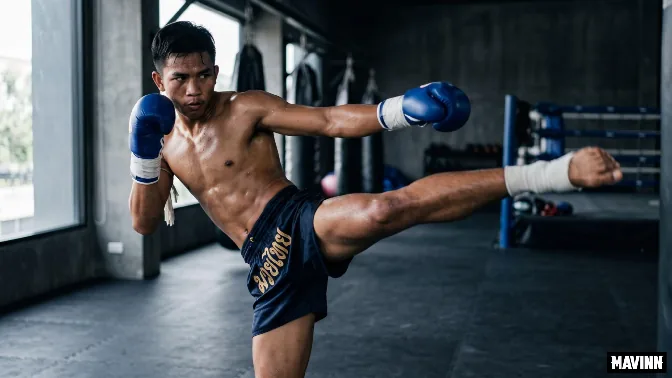
You master how to learn muay thai by building a foundation on the basic stance, the jab-cross combination, and the lead roundhouse kick before attempting complex strikes. Your stance dictates your balance and defensive capability, requiring your feet to remain shoulder-width apart with your weight distributed 50-50 between both legs. Maintaining this posture keeps your hands raised at eyebrow level to shield your chin.
Once your stance is stable, you transition into executing the straight rear cross and the roundhouse kick. The cross generates power directly from the rotation of your hips, while the roundhouse kick requires you to pivot your lead foot to swing your shin into the target. Reigning ONE Champion Superbon Singha Mavinn refines these exact mechanics daily to maintain elite kicking power.
Practicing these core movements on heavy bags or with a partner on Thai pads will sharpen your defensive timing. We suggest filming your shadowboxing sessions weekly to spot alignment errors in your guard placement.
Basic Muay Thai punches from jab to hook
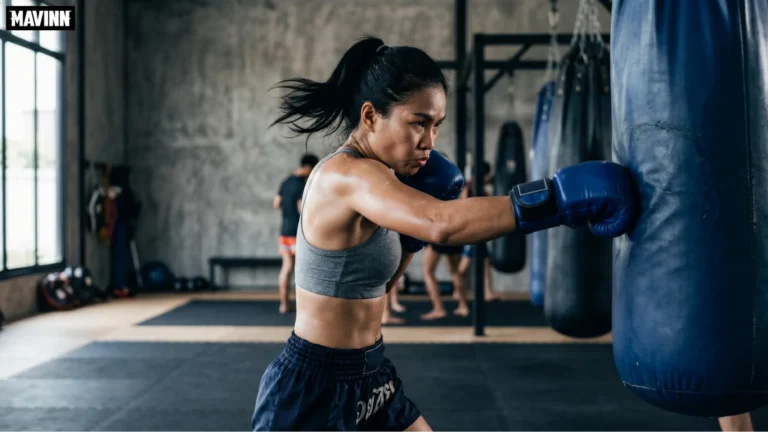
Mastering the jab, cross, and hook forms the foundation of your offensive arsenal when you want to learn Muay Thai. These three core strikes set up your high-scoring kicks, knees, and elbows. You must generate power from the ground up by rotating your hips and driving through your rear foot at a 45-degree angle.
- The Jab: Your lead-hand weapon used to measure distance and disrupt your opponent’s rhythm.
- The Cross: Your powerful rear-hand straight punch that drives forward with a full hip rotation.
- The Hook: A looping side punch thrown at a 90-degree elbow angle to bypass guards.
We train you to snap each punch and immediately pull your hand back to defend your face. Keeping your chin tucked prevents devastating counter-hooks during exchanges. Practice these transitions on heavy bags or with a partner during 3-minute rounds to build muscle memory.
Muay Thai power kicks and push kicks
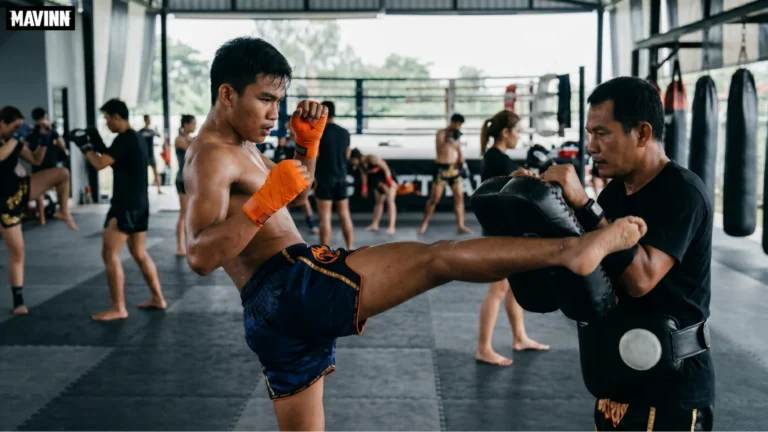
When figuring out how to learn muay thai, mastering the roundhouse kick (power kick) and the teep (push kick) is essential for establishing dominance. To execute a devastating roundhouse kick, pivot your lead foot 180 degrees and strike with the lower shin. Our world-class striking specialist Superbon Singha Mavinn employs this exact hip rotation to bypass tight defensive guards.
The push kick, or teep, serves as your defensive shield and long-range weapon to control the fight’s distance. Drive your hips forward and extend your leg, striking with the ball of your foot to disrupt your opponent’s balance. Landing a sharp teep to the solar plexus halts aggressive forward pressure instantly.
Traditional Muay Thai knee and elbow strikes
Understanding how to learn Muay Thai effectively requires you to master close-range combat using traditional knee (Khao) and elbow (Sok) strikes. These weapons require precise body mechanics, turning your skeletal frame into sharp, piercing tools. We train fighters to drive their hips forward for knees and rotate their shoulders fully to generate maximum impact. Focus on four essential strikes to build a functional arsenal:
- Khao Trong (Straight Knee): Drills forward into the solar plexus using explosive hip extension.
- Khao Chiang (Diagonal Knee): Targets the ribs by slicing upward from a 45-degree angle.
- Sok Ti (Slashing Elbow): Cuts downward at a sharp angle to slice past tight guards.
- Sok Tad (Horizontal Elbow): Swings parallel to the floor to target the jaw.
What your first Muay Thai classes look like
Your first sessions focus on conditioning, stance work, and padwork rather than sparring. A typical class opens with a rope-skipping warmup and dynamic stretching, then drills the jab, cross, and rear kick on Thai pads while a trainer corrects your angles. Bring hand wraps, gloves, and a mouthguard, and start with three sessions a week so your body recovers while building muscle memory.
For a full walkthrough of that first session, read what to expect in your first Muay Thai class. To keep sharpening between classes, follow our at-home Muay Thai training program.
Finding the best Muay Thai training in Thailand
To master how to learn muay thai effectively in Thailand, you must select a gym that aligns with your current skill level, training capacity, and lifestyle preferences. Serious practitioners should look for gyms offering a low student-to-trainer ratio, ideally 1:2 or 1:3, to ensure hands-on technique correction. For example, training in an urban hub like Bangkok (Nuanchan) focuses on aggressive fight preparation, while a camp in Pattaya allows for active recovery.
| Training Location | Primary Focus | Best Suited For |
|---|---|---|
| Bangkok (Nuanchan) | High-intensity clinching, elite striking, and fight preparation | Advanced fighters and serious competitors |
| Pattaya | Technique refinement, active recovery, and lifestyle training | Beginners, intermediate practitioners, and travelers |
Every reputable camp should offer structured curriculum pathways, ranging from online preparatory courses to fully immersive Stay & Train packages. Learning directly under world-class striking specialists like Superbon Singha Mavinn, a reigning ONE Featherweight Kickboxing World Champion, ensures you develop authentic habits from day one. Beginners should start with 1-hour private sessions before committing to twice-daily group fighter classes.
Why professional Muay Thai training accelerates your progress
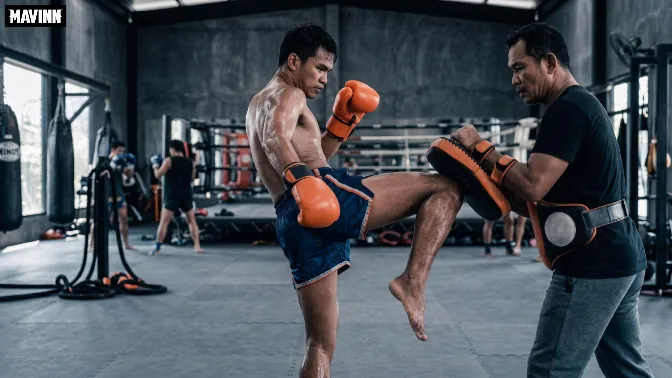
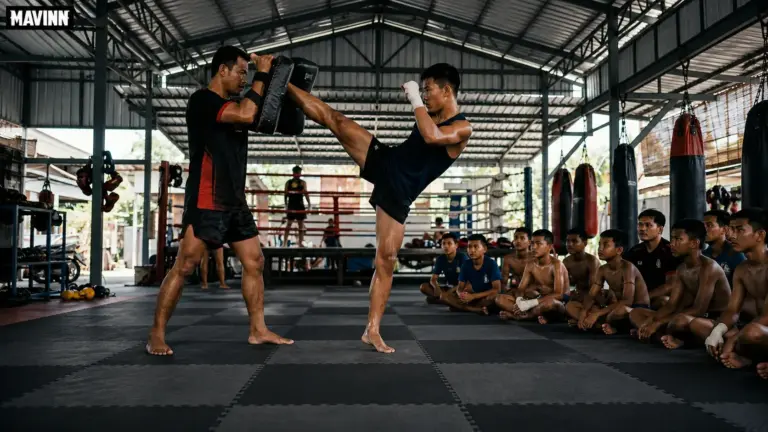
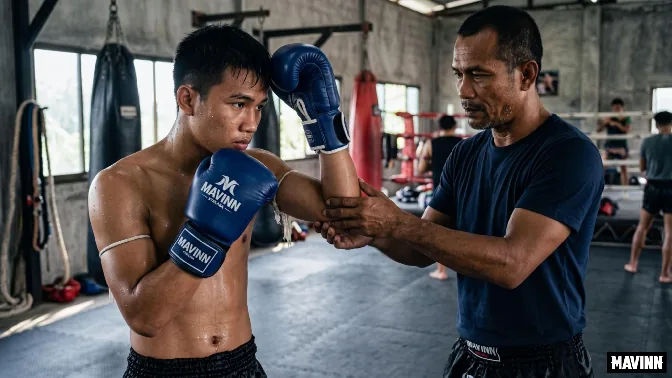
Training at a professional gym accelerates your Muay Thai progress by providing immediate, hands-on correction of your stance, hip rotation, and weight distribution. When researching how to learn muay thai, practicing alone often leads to ingrained bad habits like dropping your guard during a roundhouse kick. A dedicated facility prevents this by pairing you with trainers who spot and fix form errors during real-time pad work.
Elite pad holders mimic the unpredictable movement of a live opponent, which sharpens your reaction speed far quicker than solo shadowboxing. Training alongside active fighters exposes you to advanced defensive setups and realistic sparring drills that simulate actual ring pressure. For example, catching and countering a live teep kick builds the split-second muscle memory that solo training cannot replicate.
Train with mavinn muaythai packages in Bangkok and Pattaya
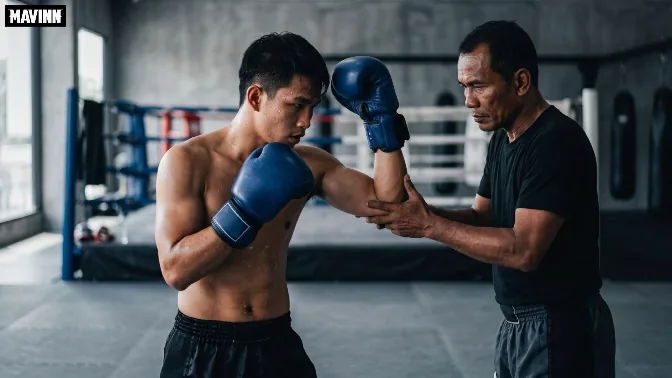
You can master how to learn muay thai rapidly by matching your training with our structured packages designed for serious athletic progression. We offer intensive programs developed by Superbon Singha Mavinn, a world-class striking specialist and reigning ONE Featherweight Kickboxing World Champion. These curriculums ensure you acquire authentic ring skills whether you train at our Bangkok or Pattaya locations.
| Package | Location | Best For | Focus |
|---|---|---|---|
| Stay & Train | Bangkok & Pattaya | Immersive travelers | Technical sparring and daily conditioning |
| Group Class | Bangkok & Pattaya | Local residents | Footwork, pad work, and defense drill reps |
| Online Course | Remote | At-home learners | Shadow boxing and striking biomechanics |
Each package delivers intense physical conditioning and technical drilling to ensure you build functional combat habits. Our trainers strip away useless movements so you focus purely on high-percentage striking combinations. This systematic approach ensures you develop real fight power and sharp defensive reflexes.
Conclusion
You master how to learn muay thai by committing to structured, consistent physical training under the direct guidance of experienced fighters. Attempting to self-teach often leads to poor habits and improper technique that take years to correct. We recommend starting with a program that balances fundamental mechanics like hip rotation and stance stability before you attempt high-intensity sparring.
Our training system bridges this gap by offering hybrid training options, combining interactive online courses with intensive on-site camps. You can train directly with elite champions like Superbon Singha Mavinn at our fully equipped facilities in Bangkok and Pattaya. Beginners and advanced fighters alike can join our Stay & Train package to rapidly accelerate their ring skills.